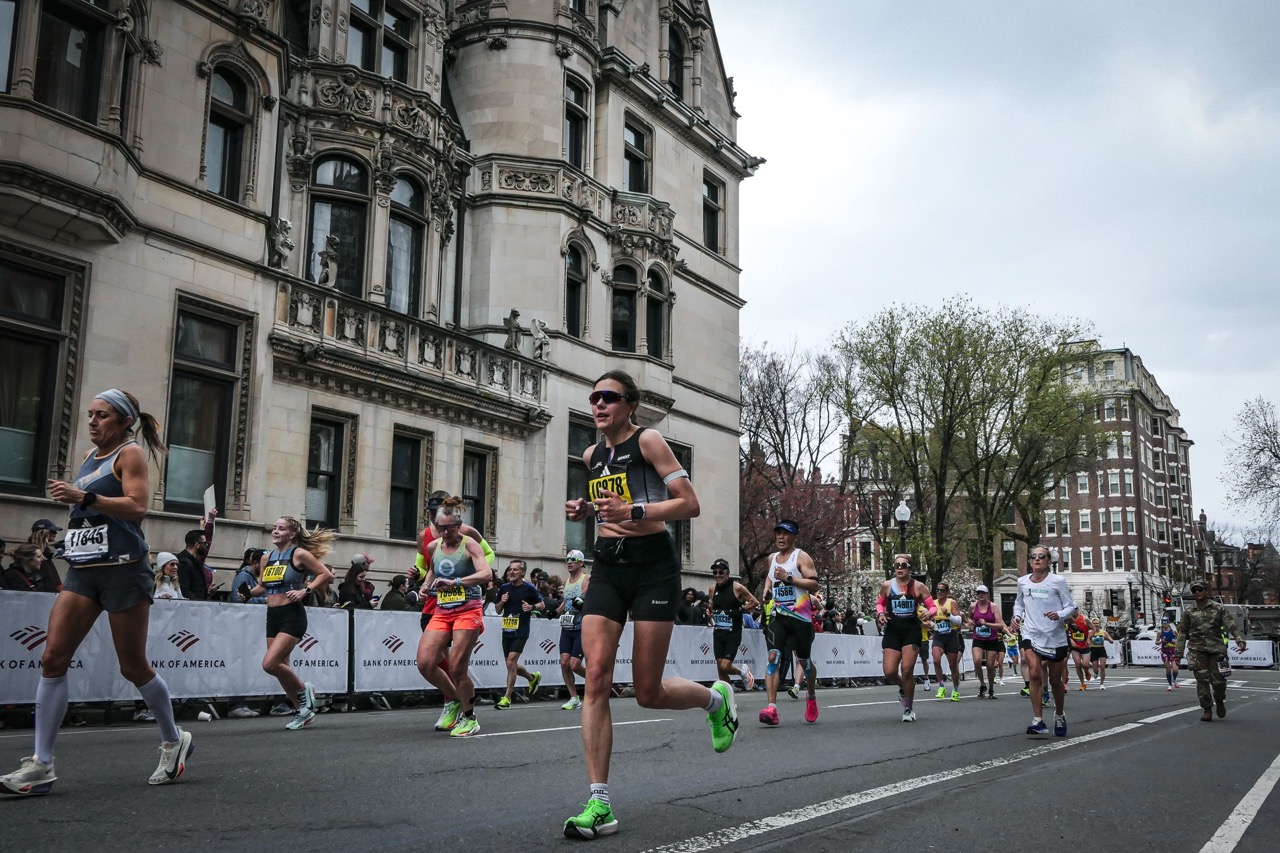
Running is meditative, cathartic, and challenging in ways that few other things are. I’m not convinced it ever becomes easier, because the fitter you get, the bigger the goals become and the faster the paces are that you reach for. Running feels equally grounding as it is freeing, especially when you leave the AirPods at home and are left with just the thoughts in your head and the sound of your feet (try it, trust me!)
In high school, I remember how long 400 meters could feel, especially with hurdles in the way, the burning in my legs and a metallic taste in my mouth as I reached for speed and another gear to propel me to the finish line. In college, running a half marathon felt like a scary but doable goal, a significant jump in distance compared to even the longest workouts we did at track practice.
I still remember training for my first half marathon through the heat of the summer and needing to take walk breaks to catch my breath. I felt invincible breaking two hours in a half marathon for the first time nearly four years later, Alessandra and my mom cheering me on with the cutest hand drawn posters at the race in Houston, Texas.
I remember feeling both a sense of accomplishment and pure relief when I crossed the line at my first full marathon in New York City, knowing I met both my time goal (and had actually completed the distance) despite unrelenting calf cramps.
I don’t recall the exact moment when I was first mesmerized by the lure that is running the Boston Marathon, but a couple weeks ago, in a haze of taper-week-fueled-nostalgia, I found and leafed through old running journals to reflect on the journey it took to get here, and the many miles that led me to the present moment. Reading through old entries, one in particular caught my eye:

I knew that the thought crossed my mind back then, but it felt surreal to see that dream written down so explicitly and staring back at me. After finishing my first marathon, I was so excited about the future and ready to set big goals. That next spring, I also hired Katie as my running coach, and it really felt like the start of something great. One marathon under my belt, I was excited to see how I could improve and build more endurance.
A couple weeks ago, Katie and I were discussing my race plan for Boston, what paces I should start at, how to approach the hills on the back half of the race, and where to conserve energy. As we chatted, Katie recalled our very first conversation back in the spring of 2020 when I shared that running Boston was the next big goal of mine. At the time, I didn’t know how upside down the world was about to become just a couple weeks after that initial conversation.
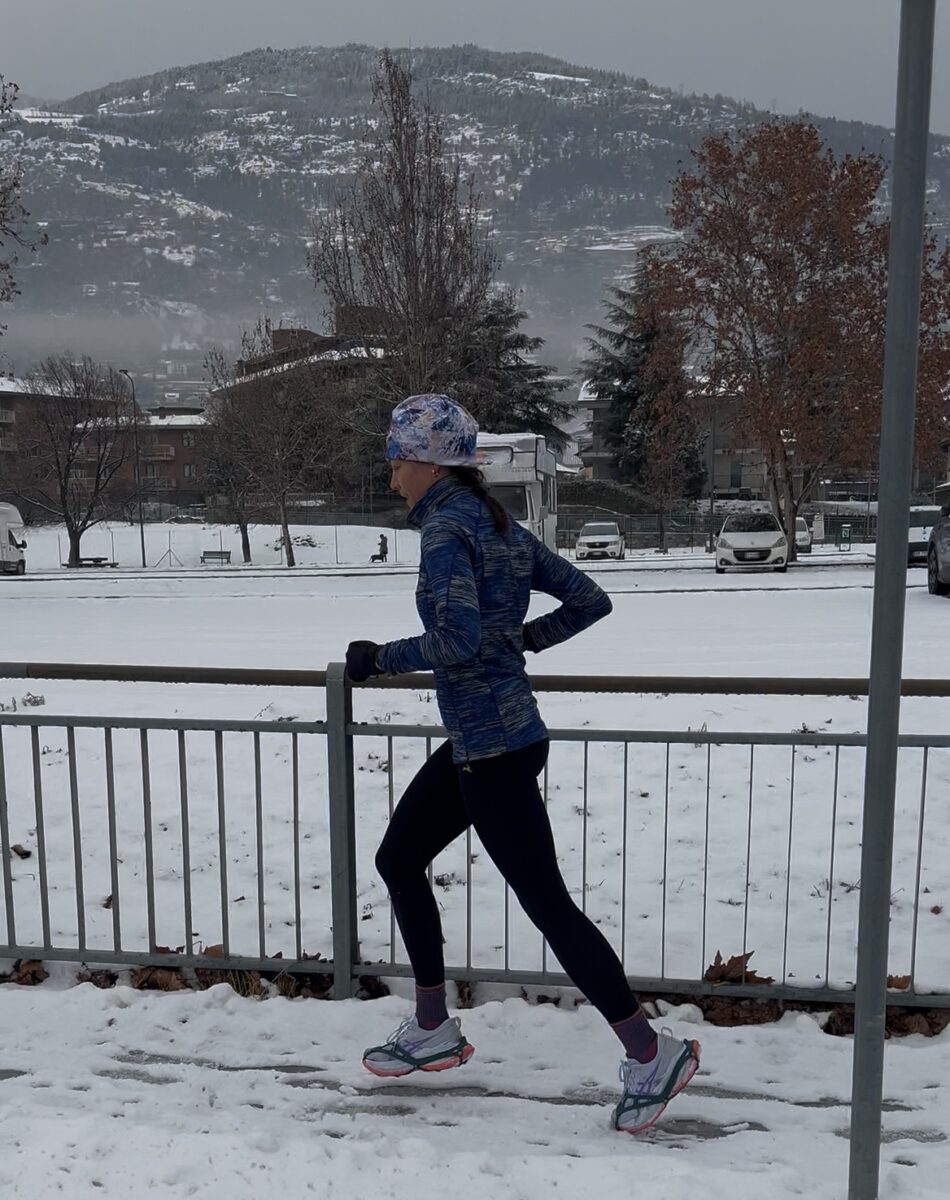
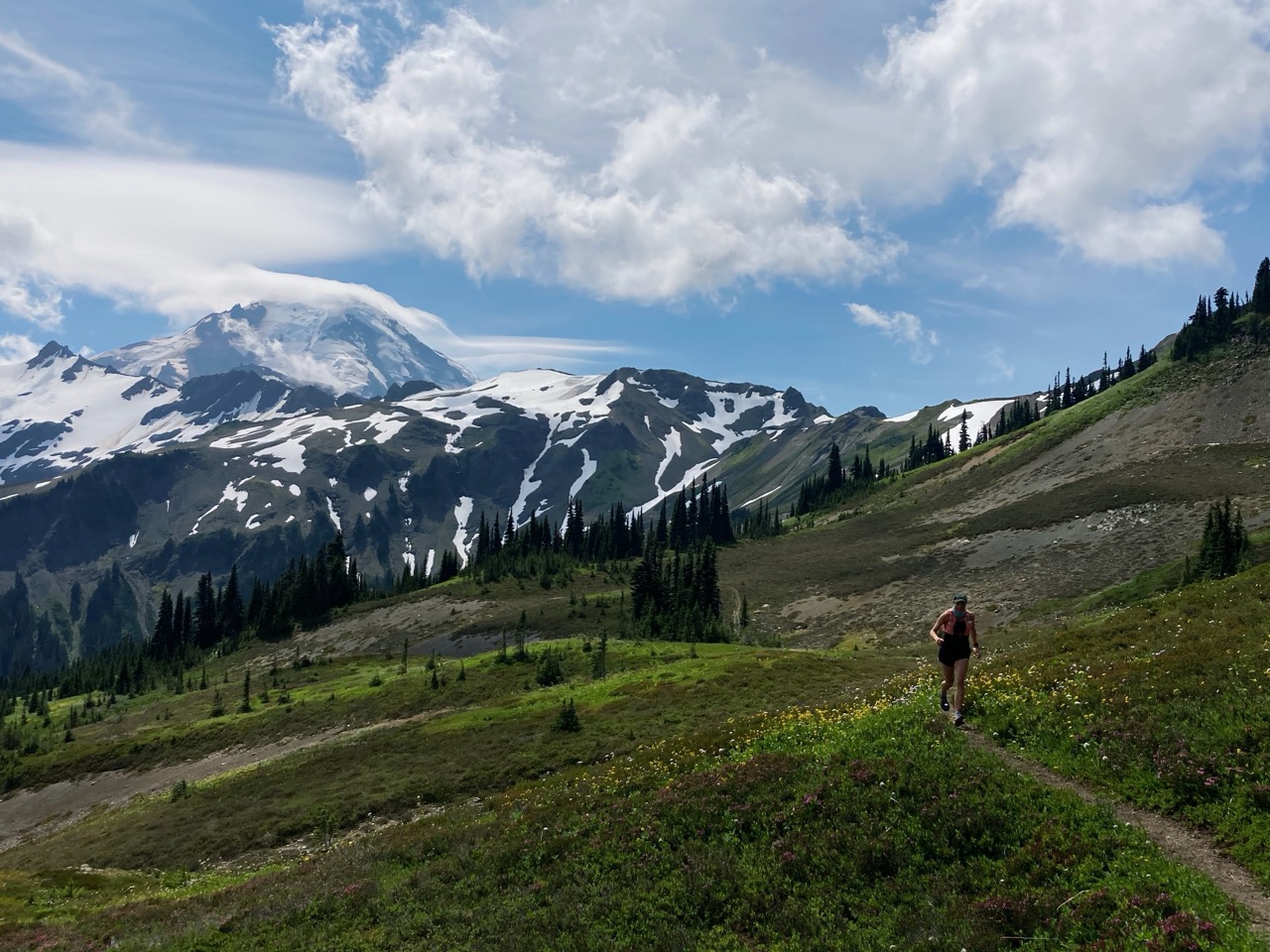
Even though it was already part of my routine, running became even more essential for my mental and physical health when COVID shuttered us all from many of life’s simple pleasures, and each other. Even without races on the calendar, I laced up daily and proceeded to run over a thousand miles that year. Still living in the Pacific Northwest, I also discovered trail running and even had the thrill of earning a couple of top place finishes for the first time since high school track!
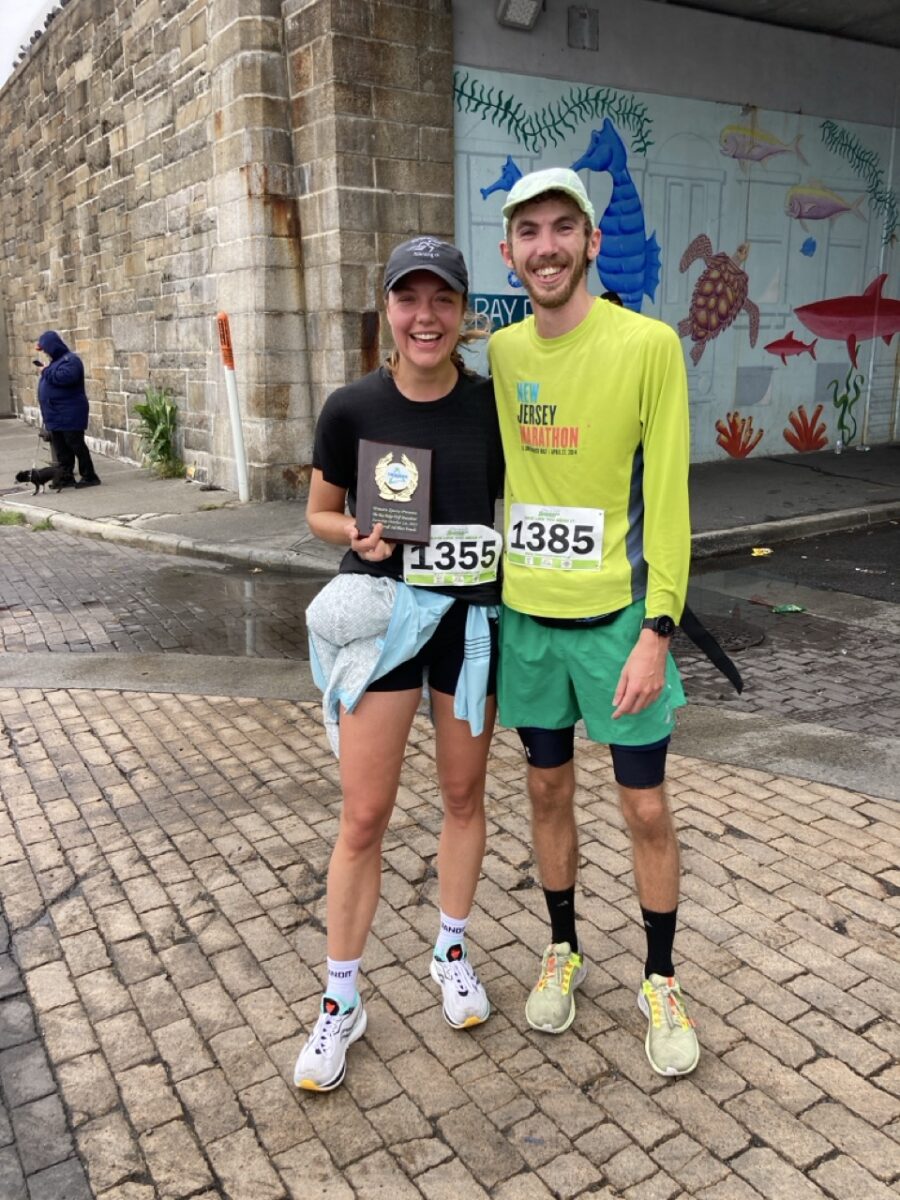
By 2022, I had kept up with running consistently, but had not yet attempted another marathon. I dialed up training that fall, soon after moving to NYC, setting a new personal record in the Half Marathon distance and placing 3rd Female Overall at the Bay Ridge Half Marathon in monsoon-like weather (a shoutout to my friend Ryan for his brilliant pacing and letting me draft off him!).
Week by week I was building toward my first Boston-qualifying attempt at the California International Marathon in December, only to be sidelined 4 weeks pre-race by a disc injury caused by pedaling wrong on a Citi Bike. It was disappointing realizing I couldn’t run as I hoped, but that upset was soon eclipsed by much greater loss.
Unexpectedly, we had to say goodbye to our family dog, Denali. Within days, we also lost my Uncle Ted. It felt like the floor was taken out underneath me.
My travel out west had been booked for months and I considered canceling the entire trip. I’m grateful I didn’t, because spending time with friends was a salve I needed as was the reminder that joy and grief coexist, often in very close proximity.
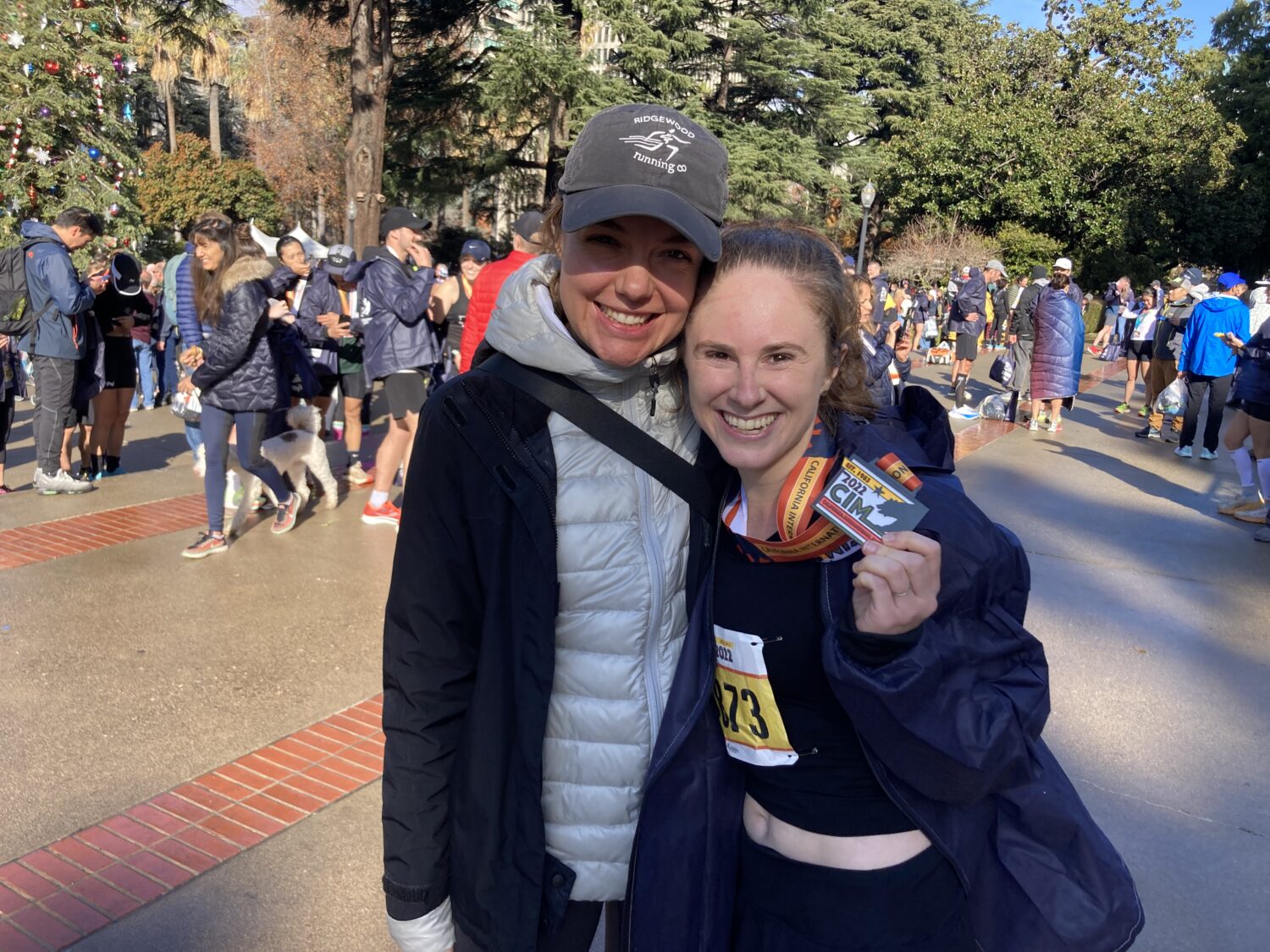
Even though I wasn’t cleared to run the marathon by my PT, I packed my skis as skiing was PT approved so long as I did not fall. Spending time in nature was healing during a really tough period, as was watching my friend Amy run an absolute-dream-of-a-race earning a huge PR and her first BQ on a perfect day in Sacramento. Bearing witness to a friend’s triumph is without a doubt one of life’s greatest joys (and I needed that!)
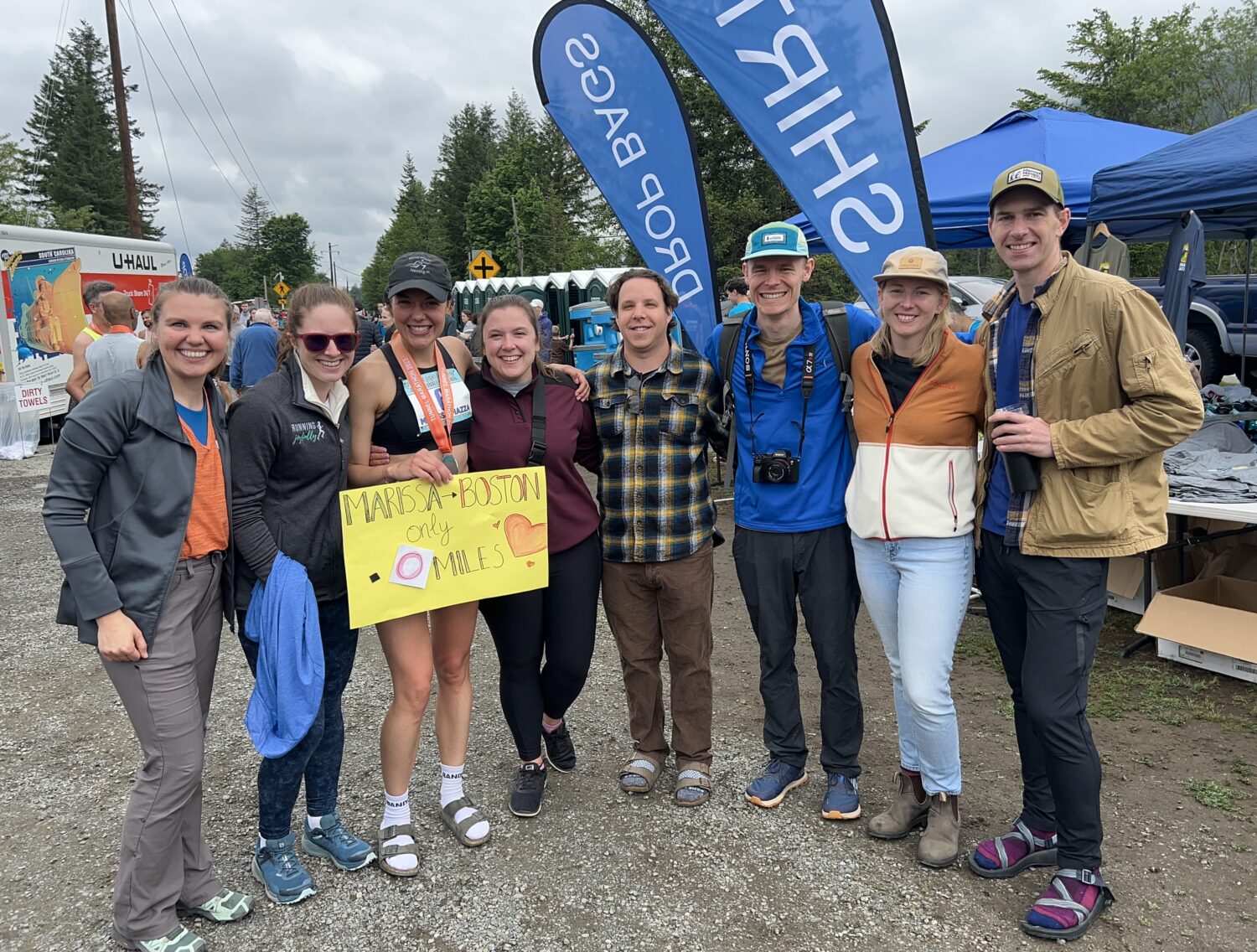
That next spring, with a healed back (and a slowly healing heart), I got back to work with my eyes set on a June marathon back in Washington. I remember my unbridled excitement when I earned an elusive Boston Qualifying time at that race, supported and celebrated by the sweetest friends who made the weekend that much more special.
My second full marathon turned out to be about as painful as the first just in different ways, since my choice to run in the Nike Vaporfly on a packed gravel course turned out to be a bit of an aggressive choice. Hoping to shave off as many minutes as possible, and enticed by the promise of up to 4% improved running economy, I opted for the fastest race shoe on the market (despite my dislike for Nike). About nine miles in, my shins were on FIRE, likely from the rigidity of the carbon plates that refused to flex as I ran down the rocky woodland course.
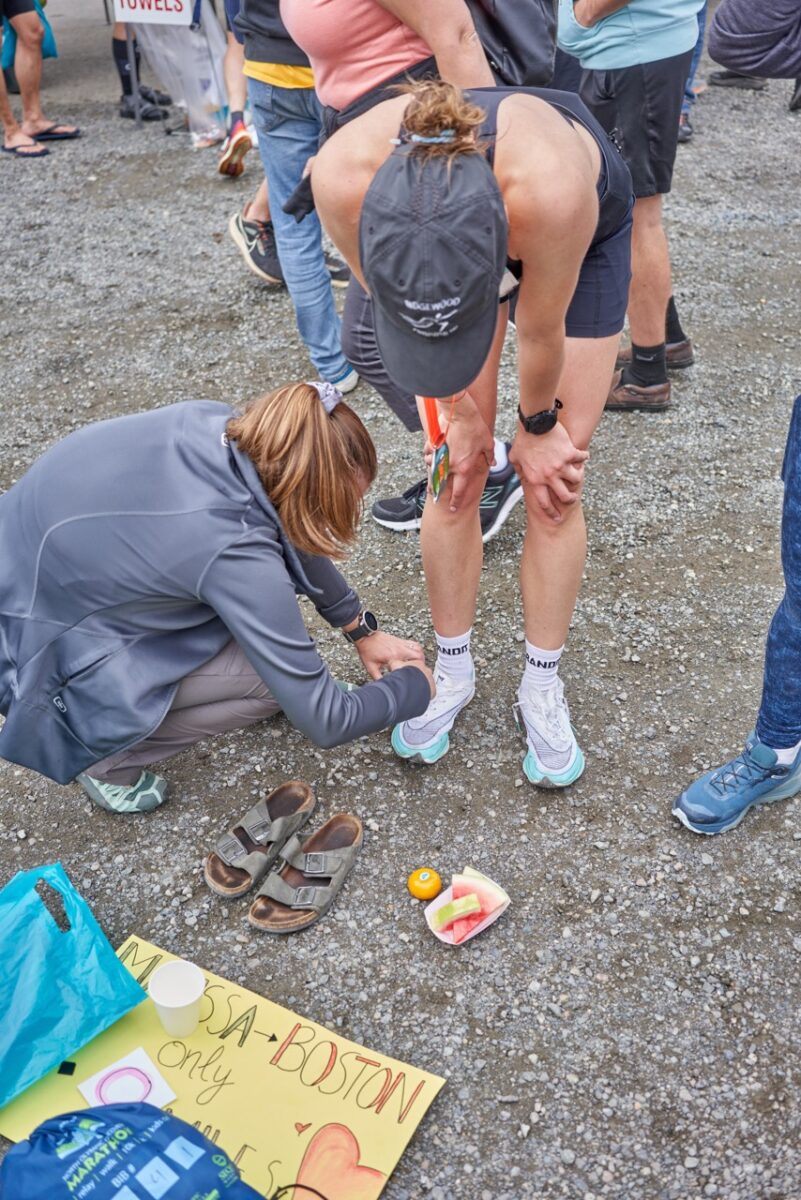
Luckily, friends cheered me on along the way and Khrystyna was right there at the finish to help me untie my laces and remove my shoes when I couldn’t manage to do it myself.
In the years prior (both the 2021 and 2022 Boston Marathons), every applicant who met their respective qualifying time was accepted to the Boston Marathon, likely skewed by the reduced number of races and qualifiers due to the lingering effects of the pandemic.
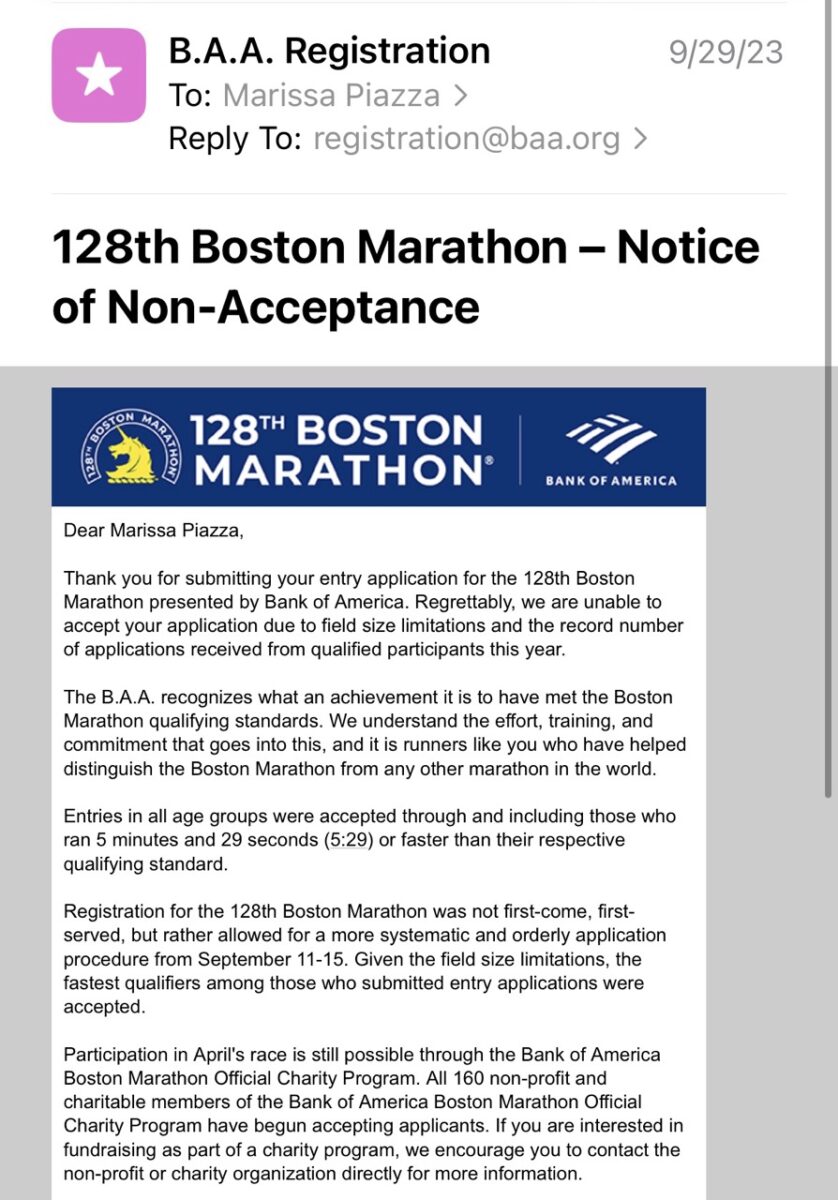
It turns out the COVID running boom was real though, and I was humbled that Fall when I received my letter of non-acceptance from the Boston Athletic Association, a reality I hadn’t braced myself for.
The 128th Boston Marathon in 2024 was a record breaking year with over 11,000 qualified applicants unable to be accepted since the ‘cut-off’ time needed to get a bib was 5 minutes, 29 seconds faster than the qualifying time standard. I missed earning a bib by 15 seconds. That disappointment stung but it also fueled me to dig deeper.
The elusiveness of Boston is part of what makes the pursuit both frustrating and motivating. The qualifying standard must be met to even apply to run the race, but that’s only the first step.
Once all the applications are submitted, the Boston Athletic Association gets to work, determining how many applicants from each age group can be accepted for a limited number of spots in the field, typically capped at 30,000 runners.
That decision-making process isn’t random, the fastest times from each age and gender group are accepted first until all the spots are allocated. I’ve been on both sides, fast enough to apply and finally for this year’s race, fast enough to earn a coveted spot.
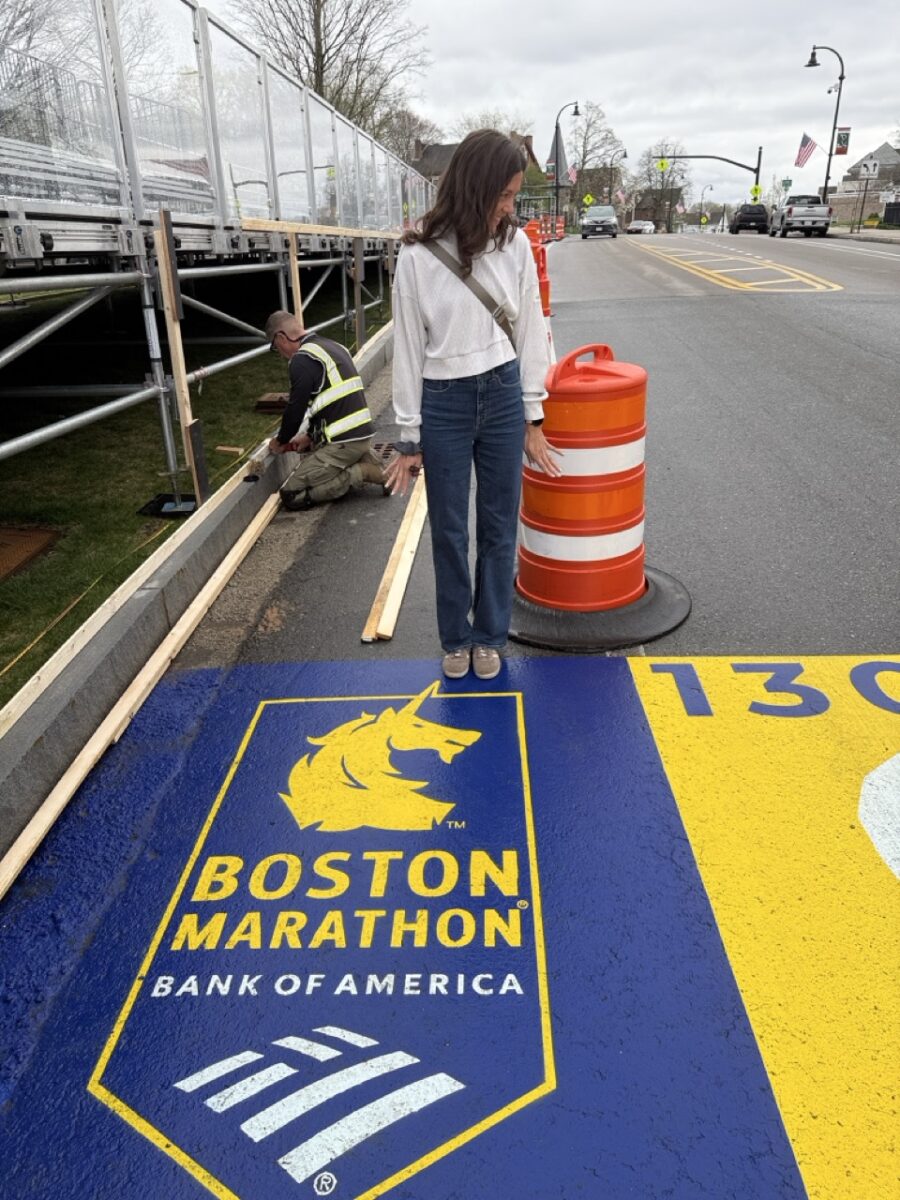
For those unfamiliar, the symbol for the Boston Marathon is a unicorn affectionately known as “Spike,” used by the Boston Athletic Association (B.A.A.) since its founding. Jack Fleming, the B.A.A.’s President and CEO describes Spike as:
“a mythological figure that is meant to be pursued, but in that pursuit, you never catch [it]…[so] it inspires you to continue to try — to race harder in the case of running — and though it may be elusive, it really is the pursuit of the unicorn that makes you better and better and better.” – Jack Fleming to Boston.com
Spike’s continued elusiveness did fuel a pursuit that would make me stronger and faster, yes, but also more accepting of outcomes beyond my control. The clench I had on races being meaningful strictly because of a time on a clock slowly loosened.
In that space, I cultivated a deeper reverence for a sport that has already given me so much – mental clarity, physical health, friendship, community – and developed an understanding that even a perfect build doesn’t protect you from missing a goal. And as it turns out, sometimes an imperfect build can lead to a near perfect race.
When the sting of non-acceptance to the 128th Boston Marathon faded, I set my eyes on running the Chicago Marathon the Fall of 2024.
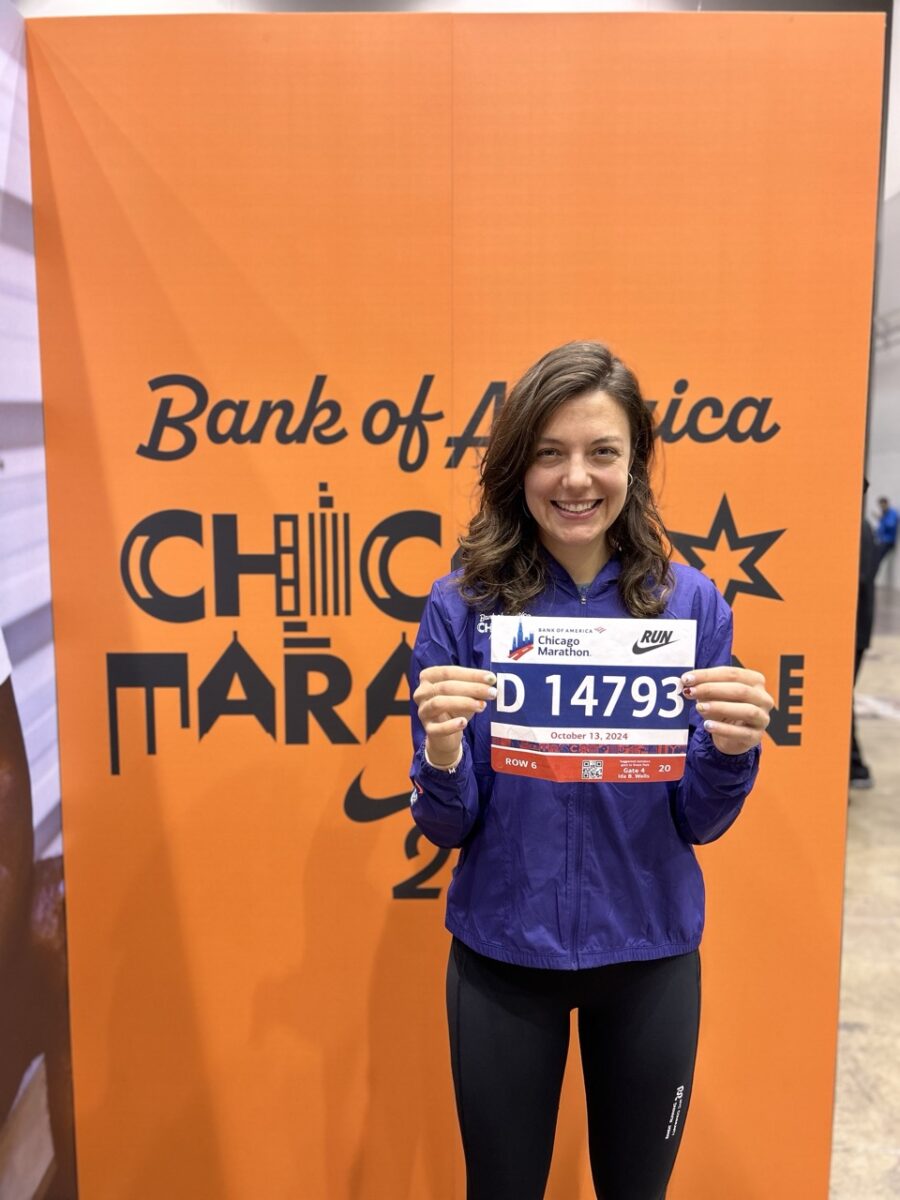
It turned out to be my strongest marathon build, topping off at around 220 miles a month leading into that race with consistent 50+ mile training weeks stacked one on top of another all summer. That consistency in training paired with a fast, flat course, great weather, and an incredible group of friends and family in Chicago, cemented that weekend and race as a core memory.
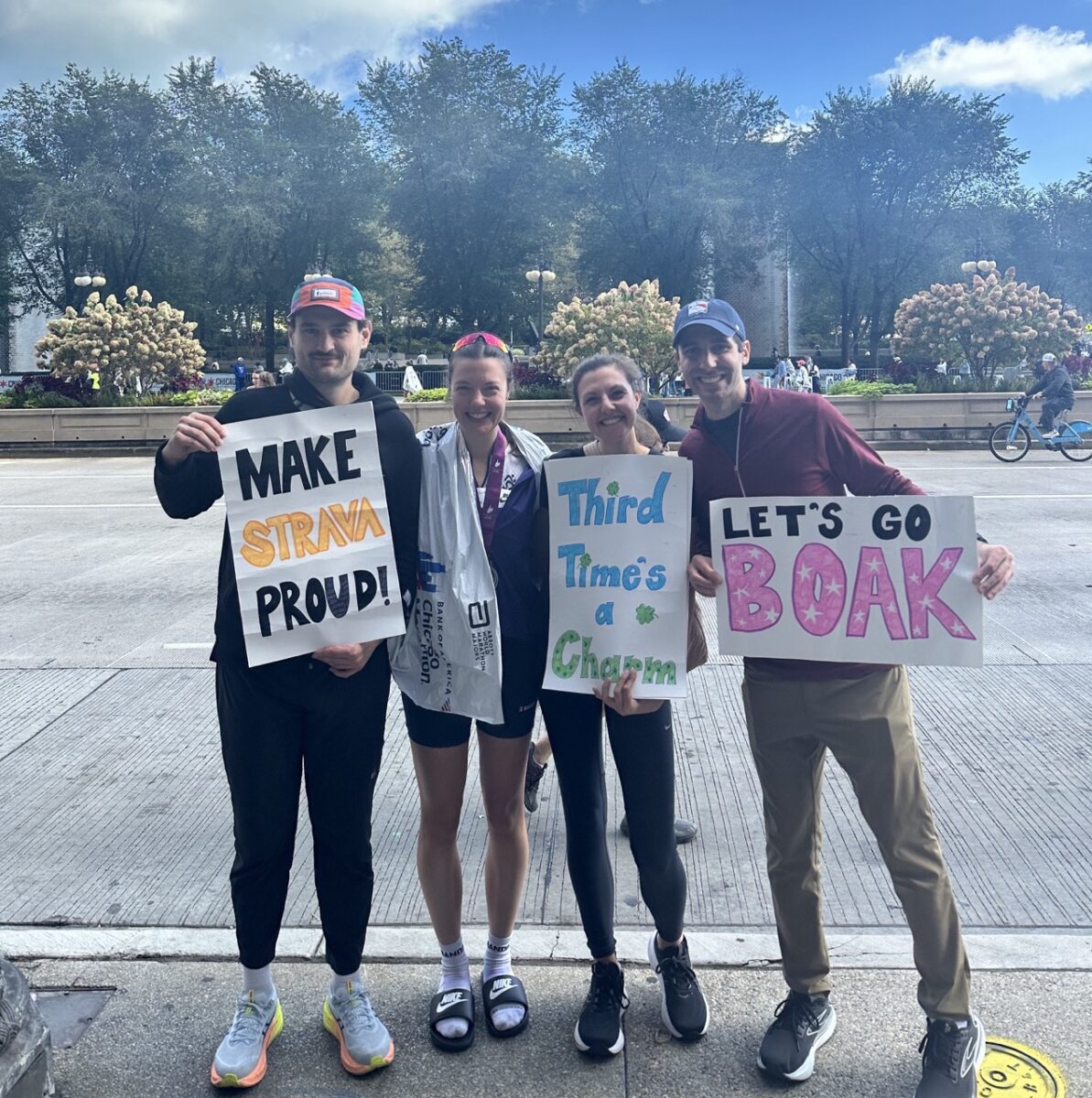
Knowing that beating the Boston Qualifying time standard wouldn’t guarantee a bib, learned from prior experience, I ran Chicago with a different focus. Rather than pinning the success of that race on a specific time goal, I wanted to run the best race that my body was capable of on that brisk October morning.
The freedom to run on “ feel” and enjoy the experience of Chicago for that race only, without as much attachment to the outcome, was a silver lining I didn’t expect from my non-acceptance to Boston. Of course, the time still mattered to me but more than that, I wanted to run a race that I was proud of and one that accurately reflected my level of fitness.
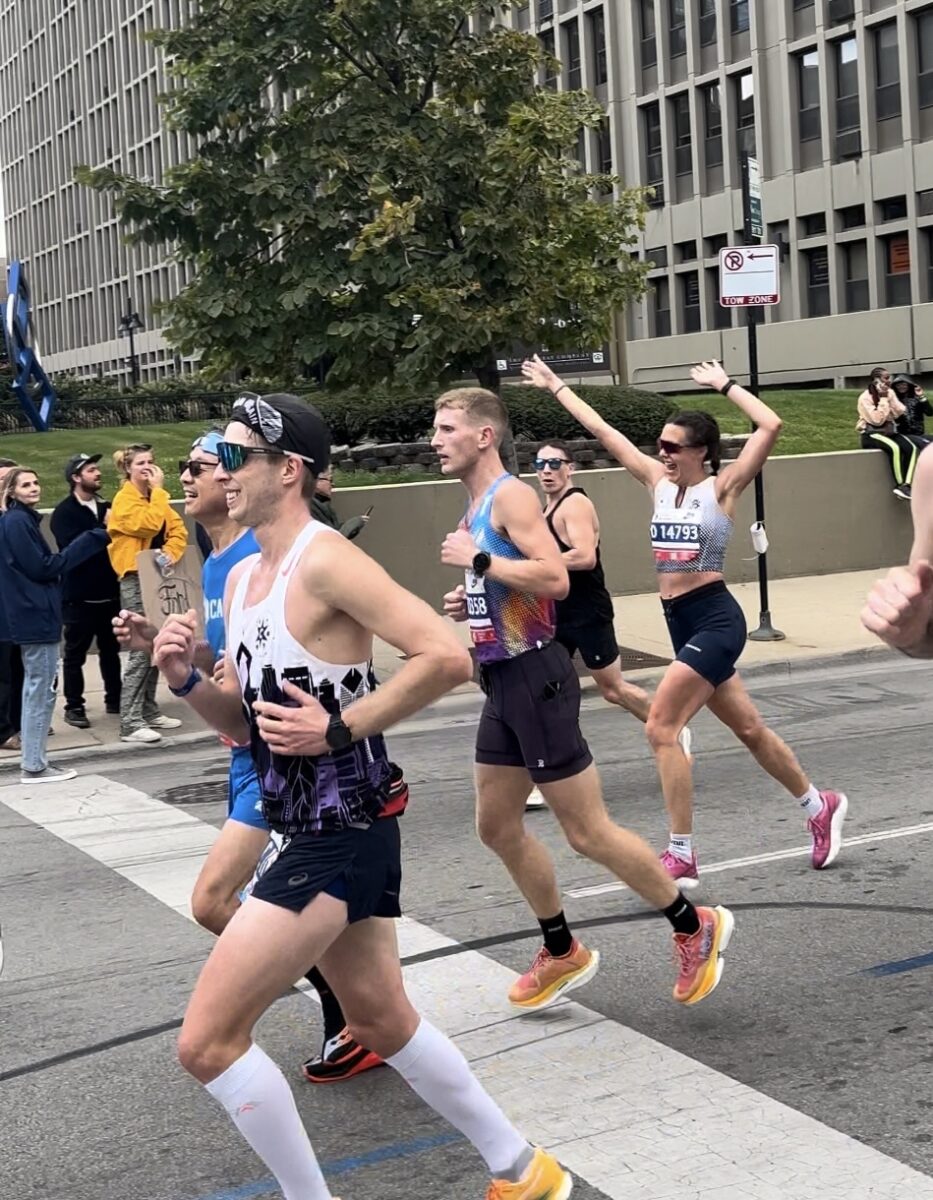
It was the first marathon I made a friend on the start line (hey Hope!). The first race I smiled BIG, grinning and waving as I passed friends and family multiple times on the course. The first race that gave me chills mid-race when I passed through what felt like a scream tunnel at the half. It was a race where I stayed calm even when I felt a cramp around Mile 18 and a race where my form held together through the final miles even when things started to really hurt.
My heart felt like it was bursting with happiness when I was reunited with everyone at the finish. I trusted my training, my coach, and my body, and it delivered.
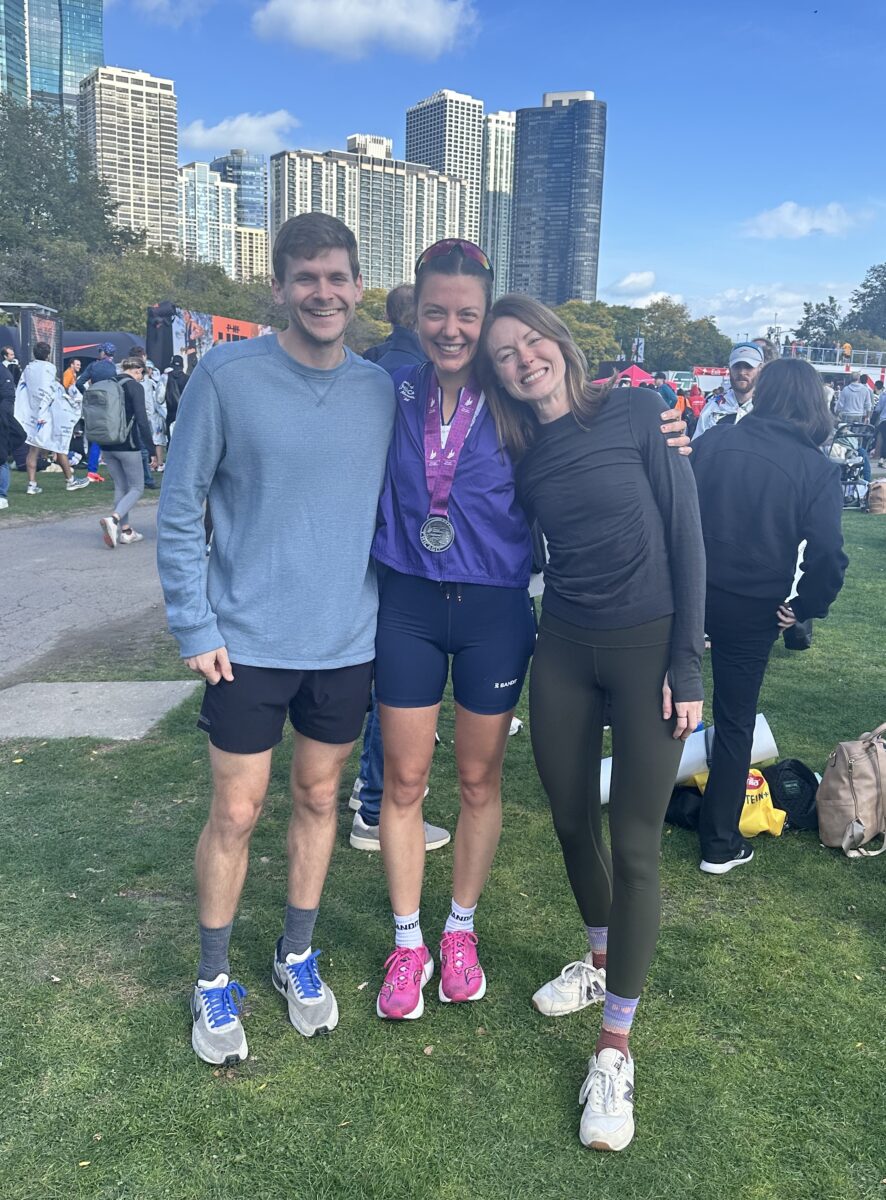
Chicago truly felt like a charmed build and race. I even gave myself a little hug at Mile 9, realizing it was the furthest I’d run in a marathon without something going terribly wrong.
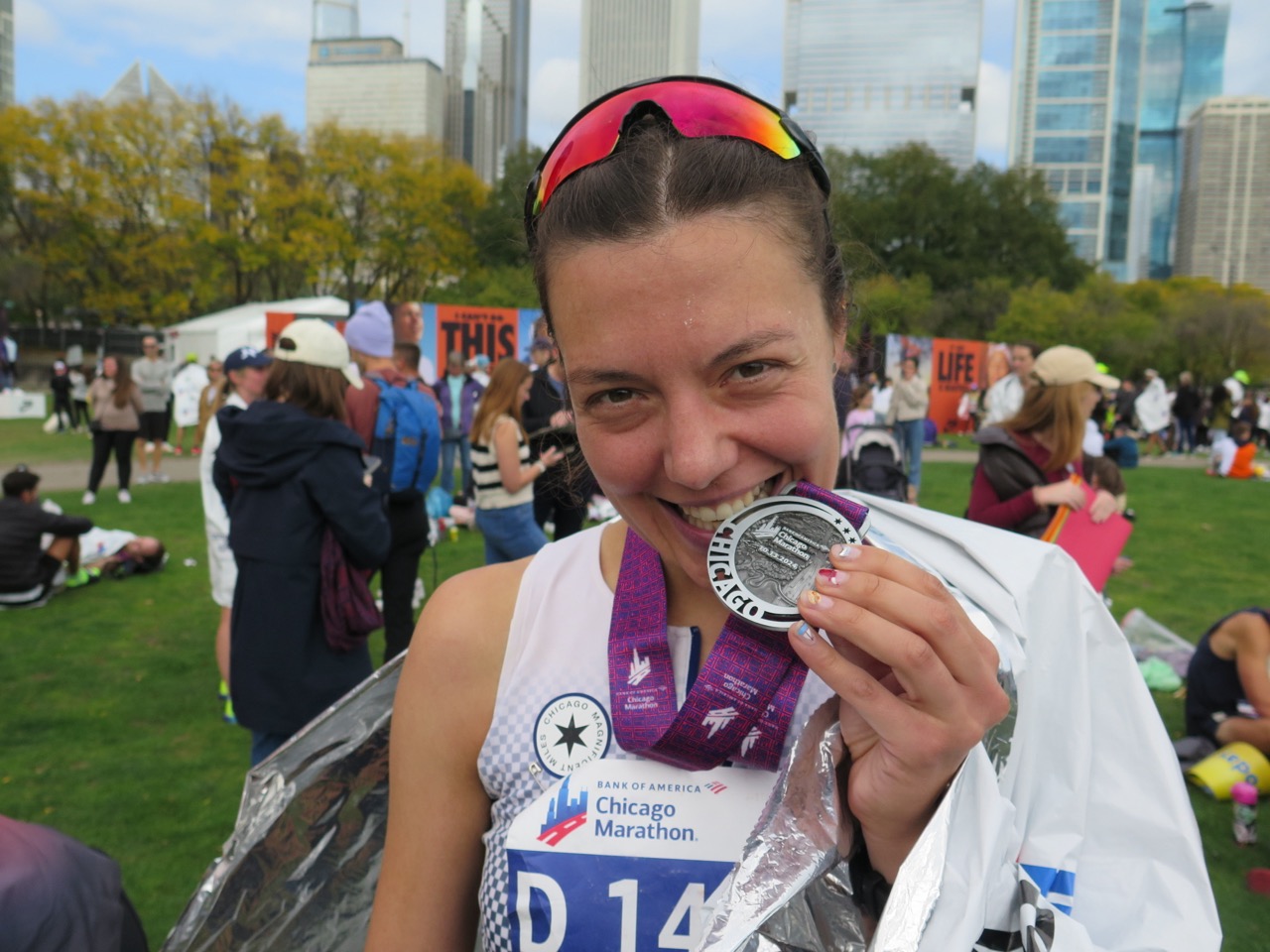
Since the qualifying window for Boston starts and ends in September, I didn’t apply to run the next (130th) Boston Marathon until nearly a year later, in September of 2025. If you had asked me what surprise could possibly beat receiving an acceptance email from the B.A.A. I would have been stumped trying to think of something.
But, as life is truly full of good surprises when you least expect, Ion proposed on September 20, 2025 coincidentally 3 days before a confirmation of acceptance landed in my inbox from the B.A.A.
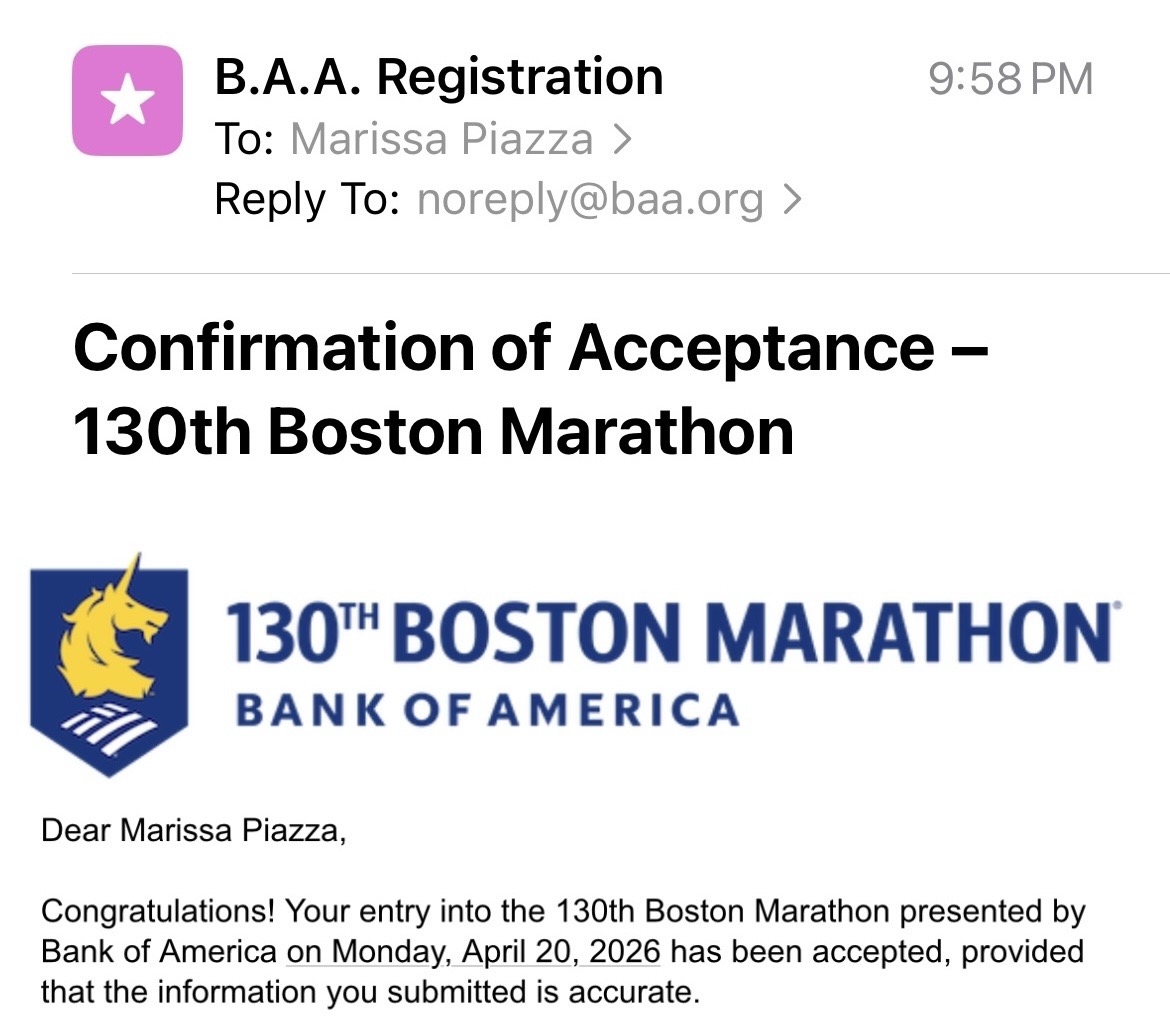
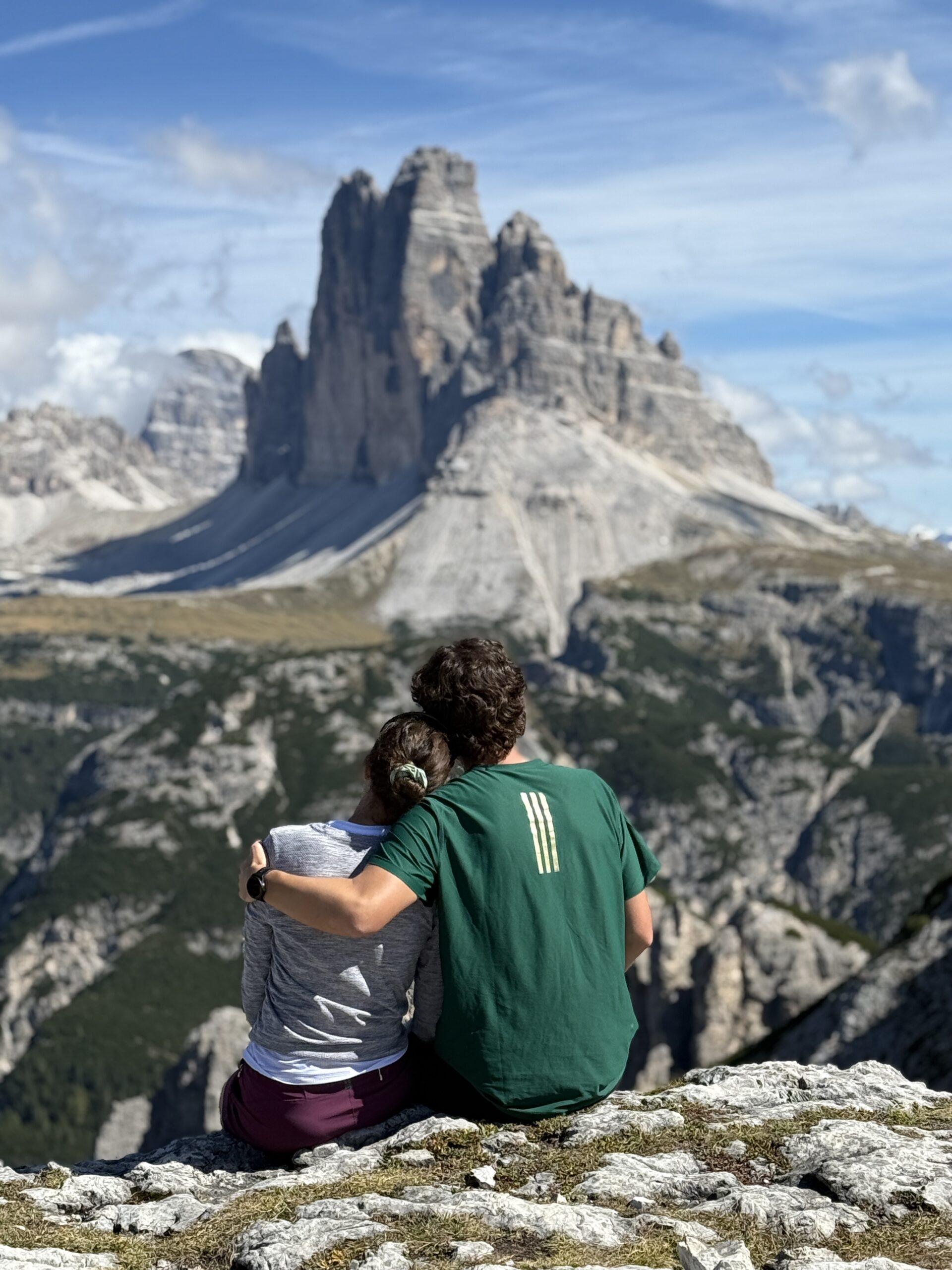
I tease Ion that our engagement is literally one of the only things that could have stolen the thunder from Boston. He won. Yes, acceptance into the Boston Marathon is epic but meeting the love of your life, that’s next level!
Aside from a bout of food poisoning mid-marathon build that sidelined me for a week or so, and a taper week that coincided with temperatures in New Jersey reaching over 80 degrees, training for Boston was honestly enjoyable! I finally learned to control my pace, run my recovery miles at a conversational pace while saving harder efforts for workouts. Even with running 7-8 hours a week, I still felt like life was relatively normal and the miles felt manageable, which is a win for marathon training!
I highly recommend adopting a 80/20 easy/effort approach to training even if it seems counter-intuitive. Spending 80% of time spent running at a conversational, “easy”, pace strengthens your heart muscle and even increases the number and size of mitochondria in your cells (If you’re intrigued, I highly recommend listening to Dr. Jack Daniels full explanation on the benefits of easy running here).
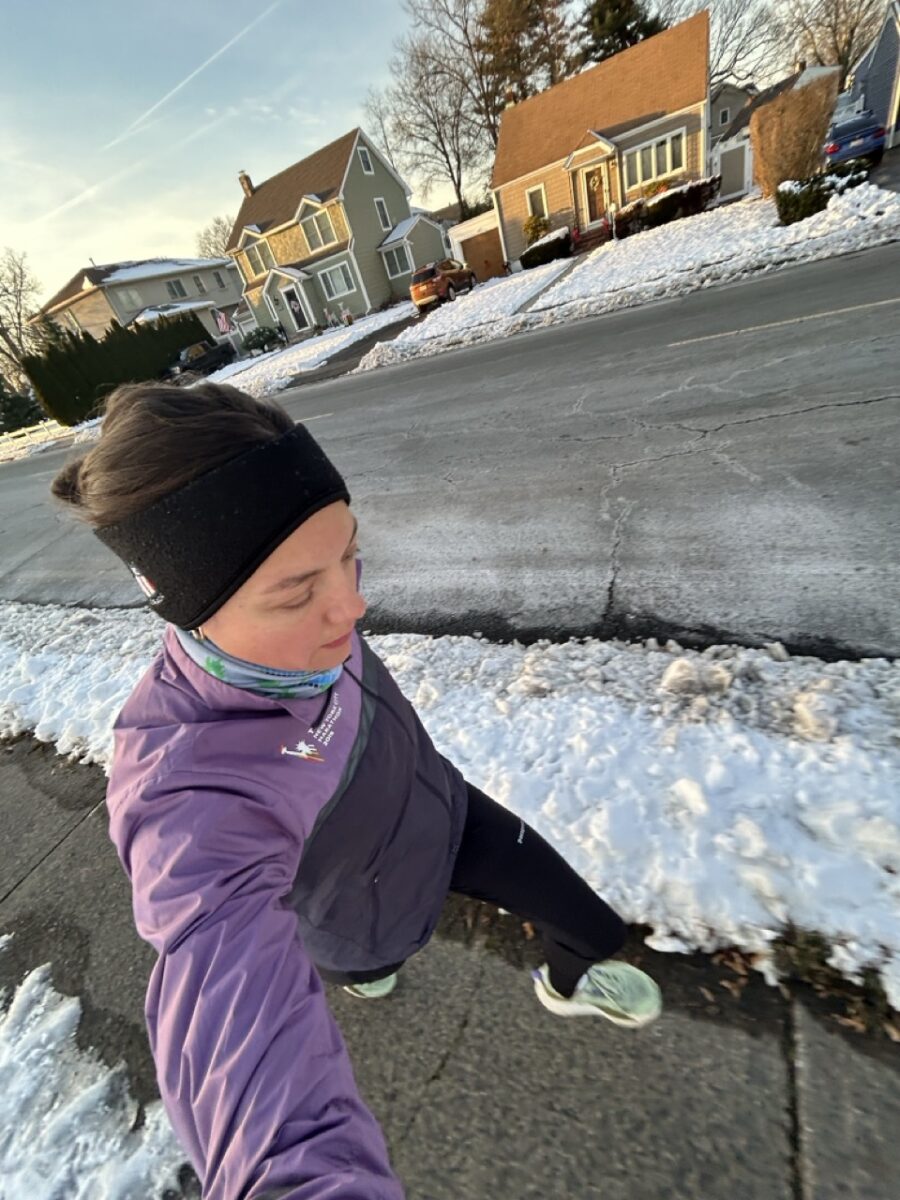
With a relatively consistent build, I wrongly assumed I would be cool, calm, and collected leading into Boston (spoiler: I was not). Tapering, in the context of marathon training, involves dropping mileage while maintaining some intensity to give your body a chance to recover and build up glycogen stores before the herculean effort that is race day! An unwelcome side effect of this process is a condition called “maranoia” which is the culmination of all the worries runners feel before the big day.
It took some (extra) time reflecting to try to analyze why my nervous system was in overdrive, but what I’ve concluded is that dreaming and striving for Boston for over six years put extra pressure on a race, that when matched with the buzzy energy around the city, pushed me a bit too far. The race meant a lot to me, and it almost felt that my identity as an athlete and a runner was at stake if something prevented me from completing this race.
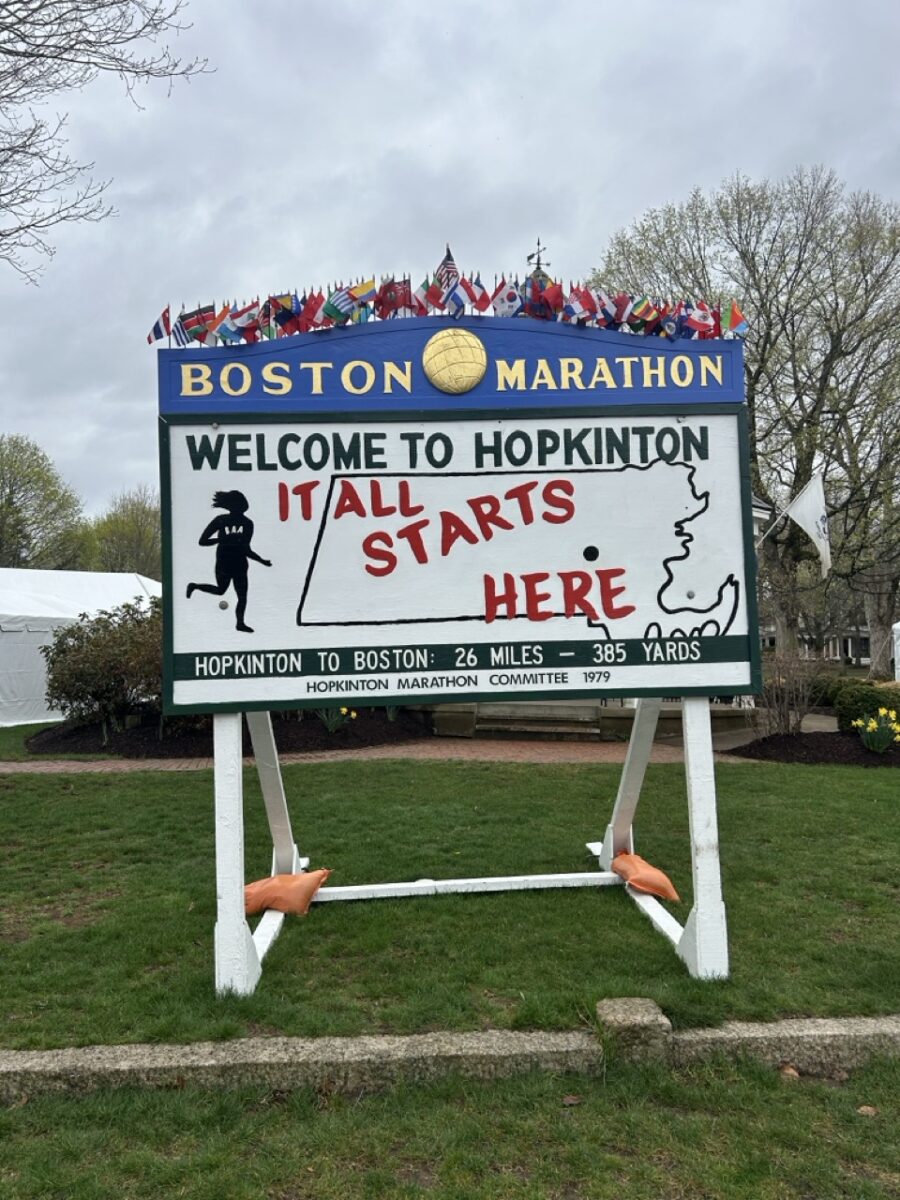
No one’s paying me to run, I’m not a professional, and I’m not sponsored (even though Bandit and ASICS did set me up with shoes for race day which was the sweetest surprise that made me feel like I was sponsored!). Still, I approach racing with commitment and intensity that makes it feel like more is on the line.
Two weeks before race day I carefully calculated the exact grams of carbs I would need for a three day carb-load and I meticulously practiced pre-race nutrition treating my last long run as a dress rehearsal by waking up and eating breakfast at 6:41AM, only to get to Boston Marathon weekend barely able to eat, my stomach in knots, and feeling so overwhelmed at the expo I almost left without buying even a Boston Marathon jacket (thankfully Ion didn’t allow that to happen!)
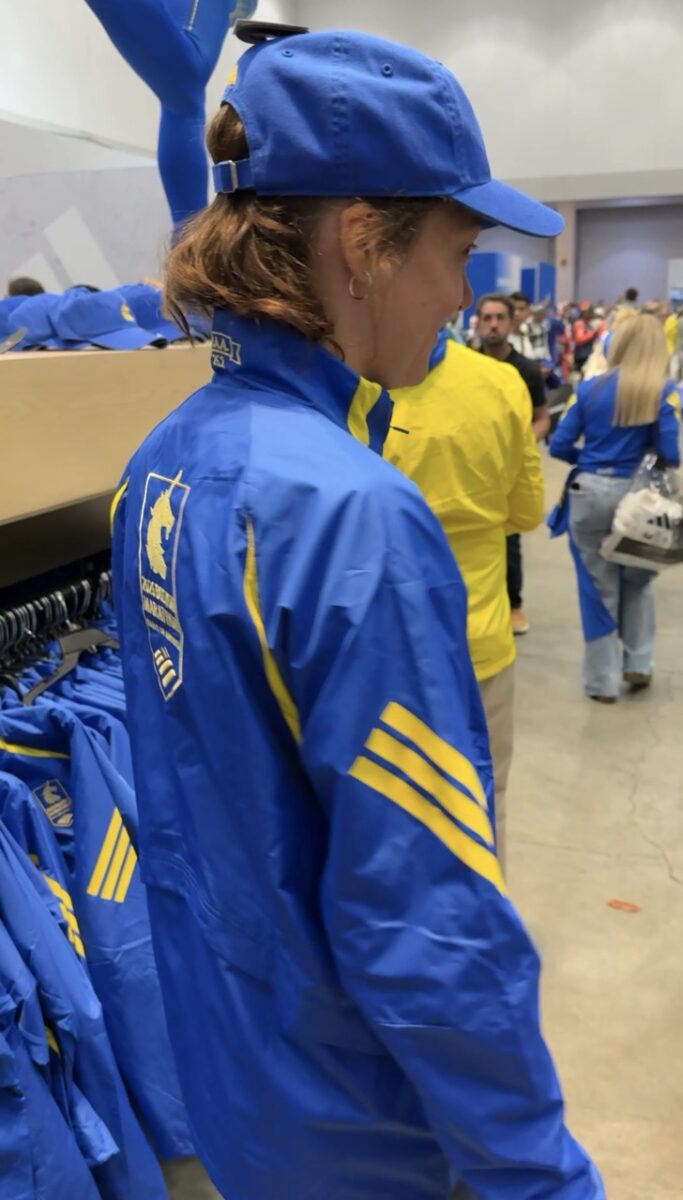
My brain felt like it had somehow short circuited and rather than imagining a dream finally coming to fruition, all I could picture was anything and everything going wrong.
Something I can’t anticipate will go horribly wrong and I won’t finish the race… I won’t be a Boston Marathoner … even if I take it easy at the start I’ll be gassed and walk up the hills… I’ll feel flat and terrible every mile… I won’t finish and I’ll be embarrassed …my nerves will wreck my ability to perform… stop being nervous or you’ll ruin everything!!!
I had somehow convinced myself everything was in fact too good to be true and something, surely, would go wrong. Life can’t be this good. Ion had me write each fear down and we verbally challenged it in an attempt to get my logical brain to turn on and stop catastrophizing but I just couldn’t shake it despite all our efforts.
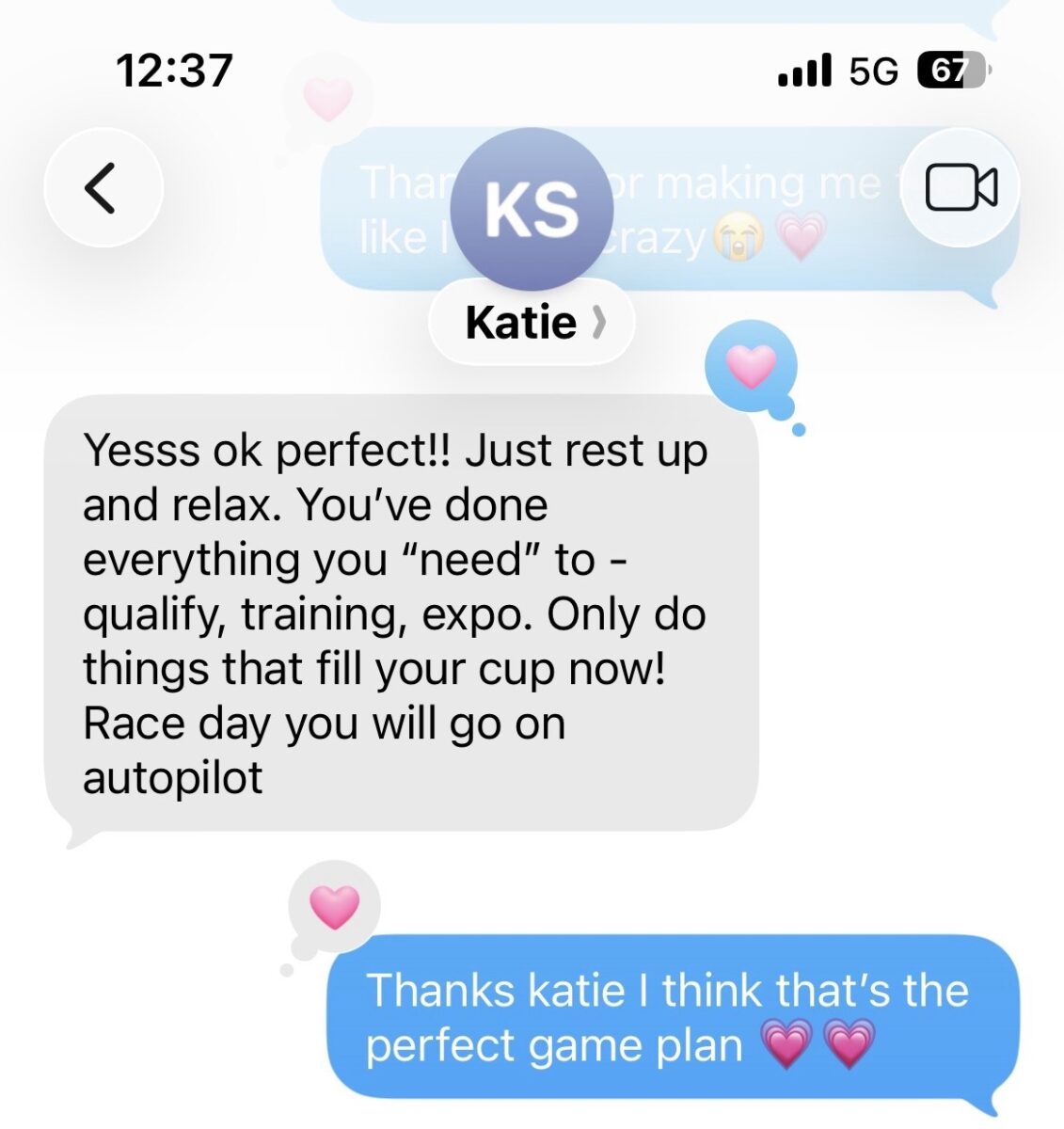
When I talked to my run coach the night before the race, she encouraged me to take care of Marissa the person, not Marissa the runner. There was no more preparation that could be done. I needed to put away the race plan, stop counting carbohydrate intake, and let my nervous system come back to baseline.
The anxious feelings still came in waves. At times I was able to quiet the negative chatter in my head but it was never silent. It was there lurking at the periphery and taunting me even on race morning. I just focused on putting one foot in front of the other (literally) and trying to shove down as many carbs as possible. I couldn’t stomach a bagel like I’d so meticulously practiced before long runs, so I packed a bag of Cheerios in my gear bag and prayed I could find my appetite by the bus ride.
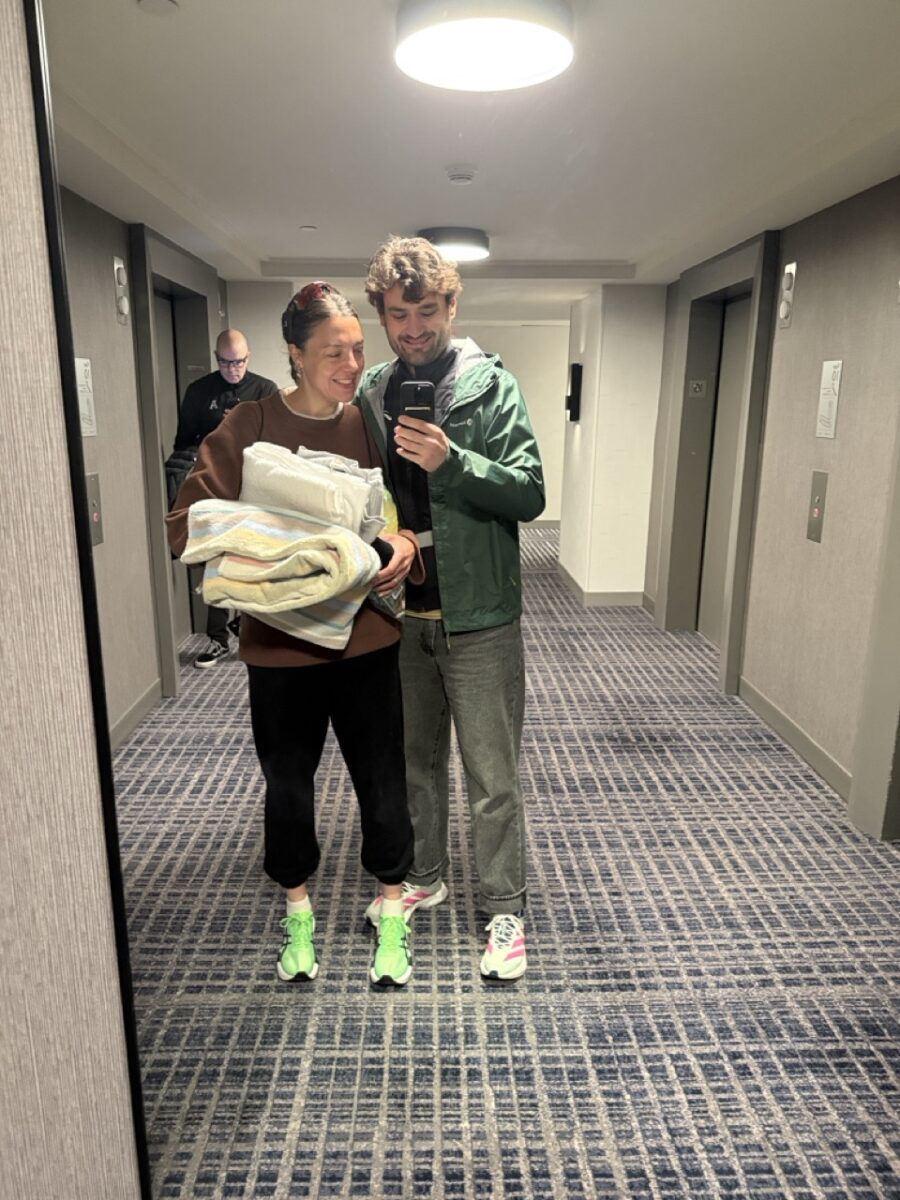
When Ion dropped me off in the Boston Commons to catch the official bus to the starting line, he gave me a big hug and encouraged me to go make some friends, knowing it would calm my nerves. Turns out, that really did help (I should have listened to him more that weekend, oops). I chatted with a woman seated beside me who flew in from India, also running her first Boston, after qualifying at the Delhi Marathon. I bumped into a friend, Caroline, soon after starting the race too! One by one, those early miles clicked off and I settled in.
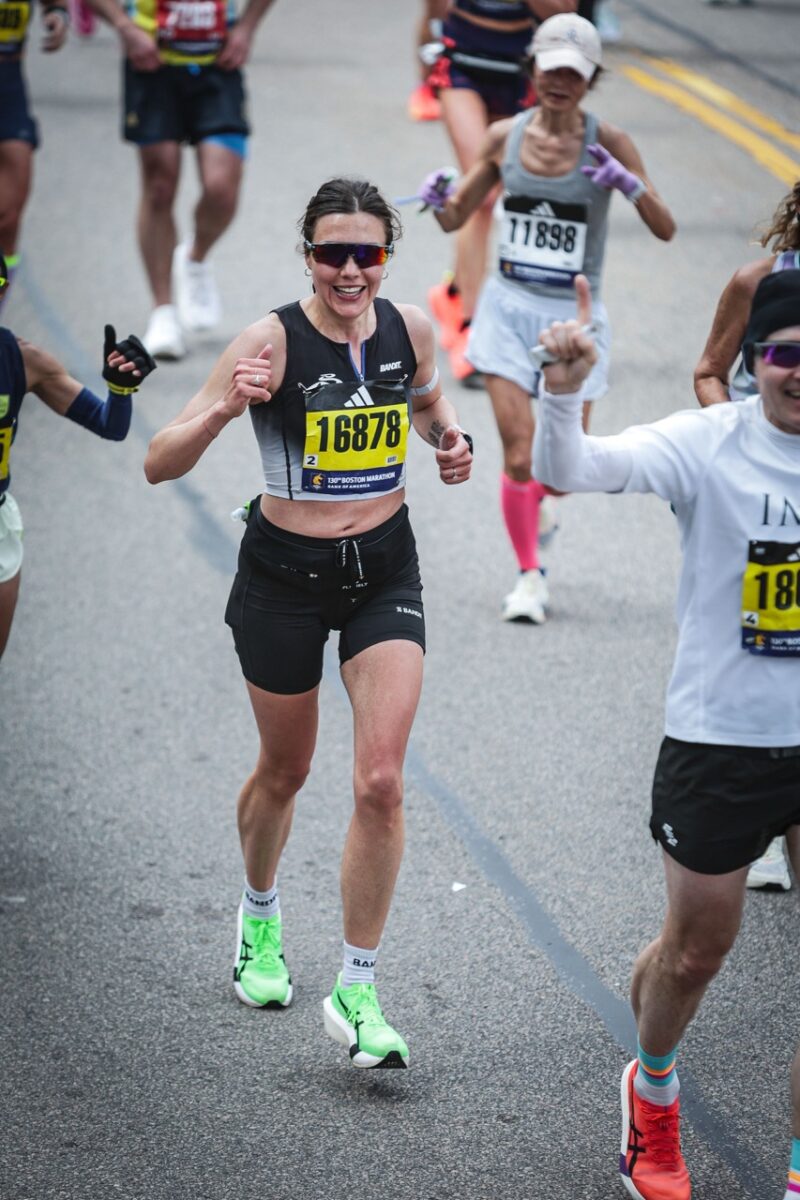
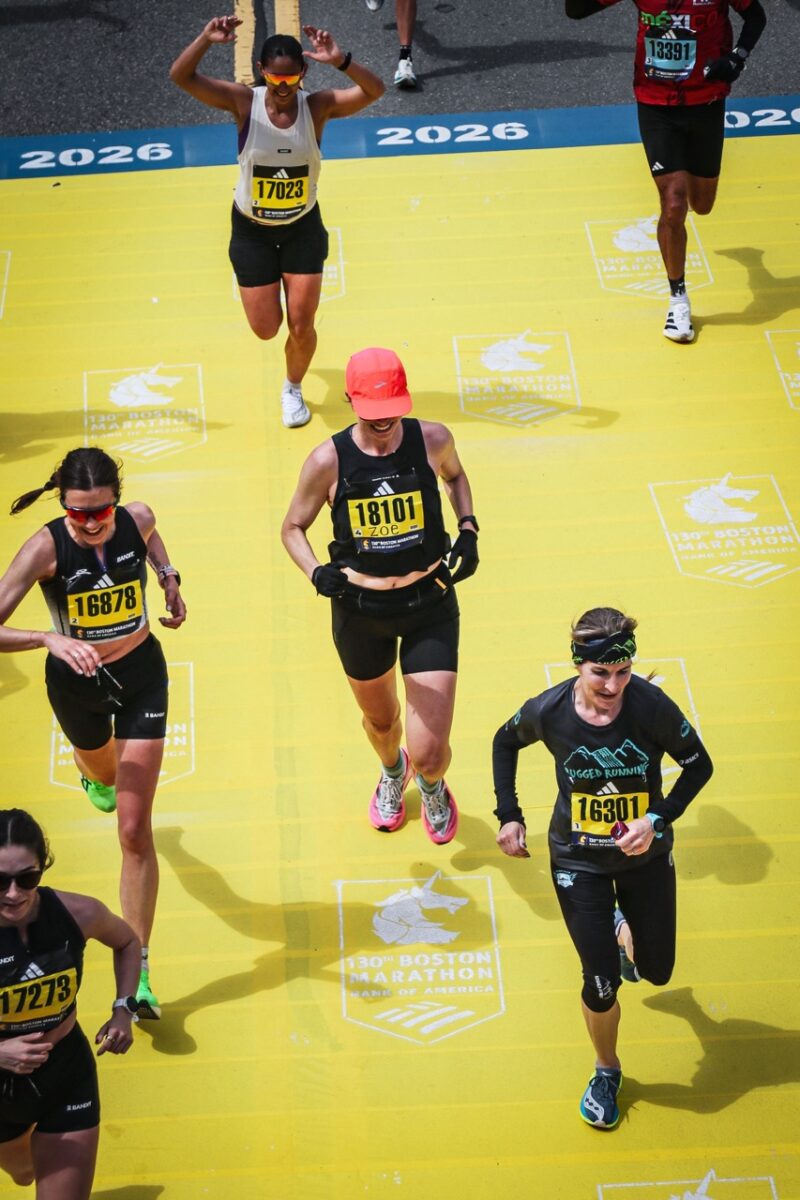
I ended up shoulder to shoulder with another runner, Zoe, as her pace perfectly matched mine. After running side by side for long enough that one of us had to acknowledge the other, Zoe broke the ice “I really like your pace, so I’m going to stick with you.” I felt relieved. Everyone in my wave seemed to be surging ahead while I was trying to heed Katie’s advice of saving my legs for the hills that were still a long way off. Zoe and I chatted briefly, compared training cycles and weather in the Northeast vs. Zoe’s base in San Diego, and proceeded to run in lockstep.
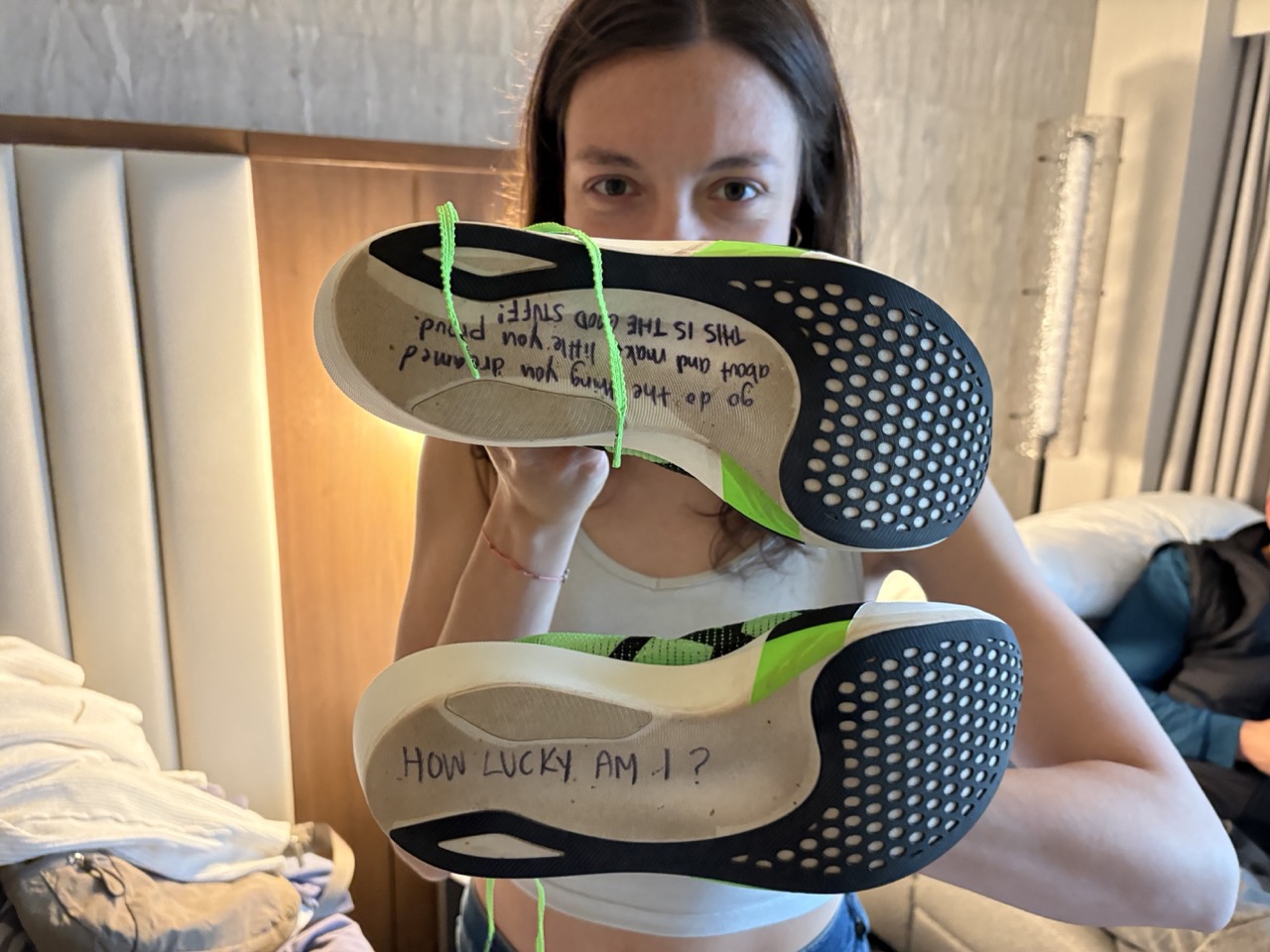
As we ran, I could feel the anxiety dissipating, I gained more confidence with each step and continued to bring my race mantras to mind: smooth is fast, fast is smooth for those sneaky, early downhill miles, how lucky am I on repeat through the middle section, and these hills have nothing on me up and through what is considered the toughest section of the course.
Katie was right all along, my body knew what to do. I was on autopilot. I wish my mind had been able to trust that. I hugged the middle of the road for most of the race, careful to stick to the tangent line, but couldn’t resist veering a bit off to high five the kids lined up and smiling along the course.
It wasn’t until around Mile 16 that I knew I would not only finish, but I would finish the race strong. Spotting my sister and Dad at Mile 17 before they even saw me, I sprinted toward them and gave them both a big hug. When my dad asked me how I was feeling as I ran off, I yelled back with a smile, “I feel strong!” and I meant it.
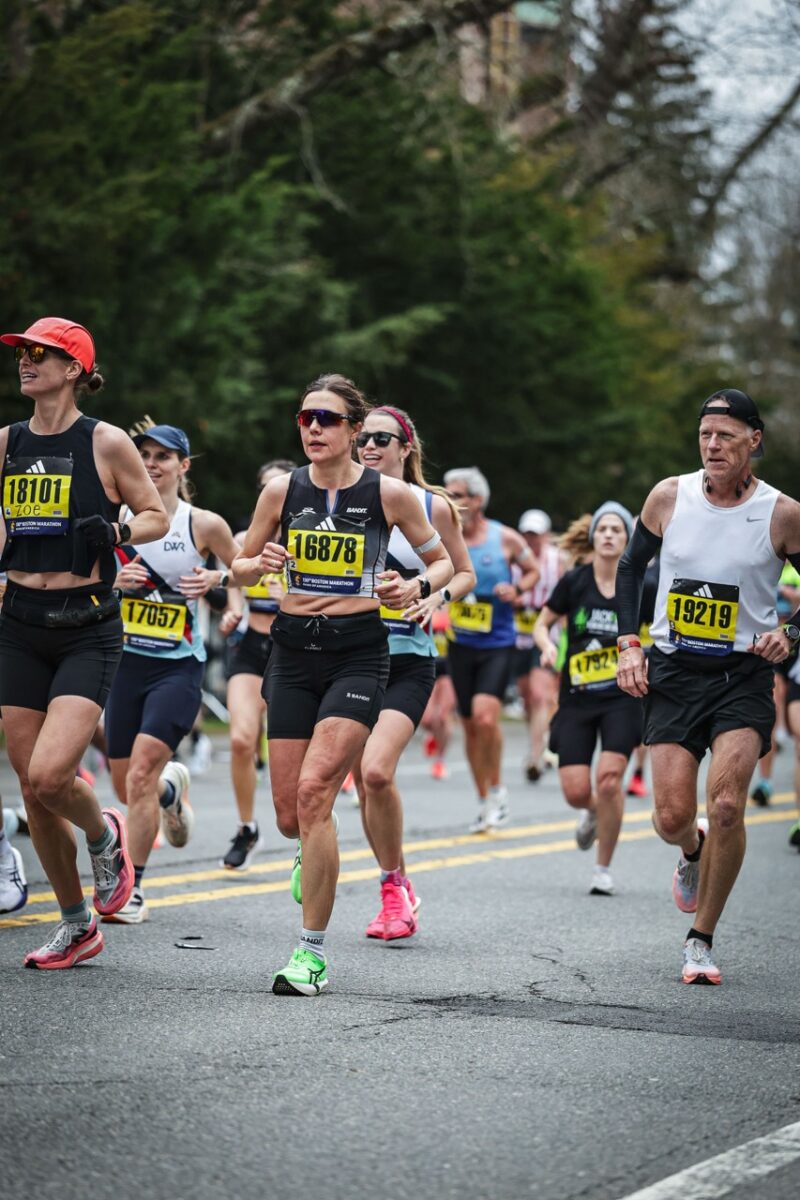
Suddenly, I shifted from a state of protection and preservation, found my fighting spirit, and started racing. I surged up the Newton Hills, even Heartbreak Hill, with a smile, throwing down faster miles up the hills than down them. The part of the course I feared so much turned out to be one of my favorites, thanks to some relief on my quads from all the early downhill miles and a newfound confidence!
My mantra for those miles held strong: these hills have nothing on me. I repeated it again and again.
After passing Mile 22, I knew I was in the home stretch. Looking down at my watch I saw my average cumulative pace had dipped into PR territory. Now or never I thought, it’s a PR at Boston kind of day if you just hold on.
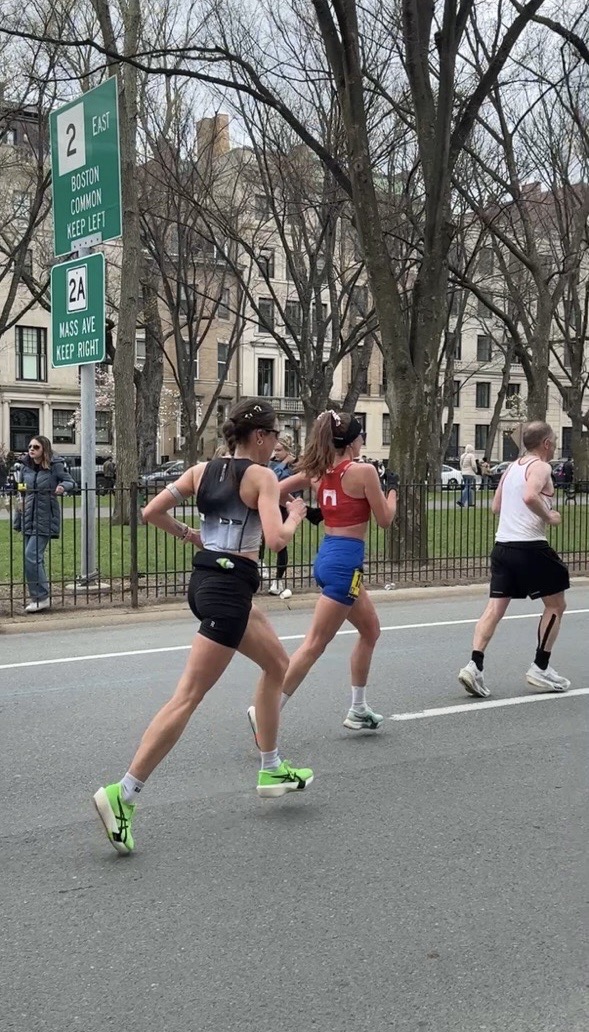
Nearing Mile 26, I turned right on Hereford and left on Boylston, the most iconic turn in marathoning and I could see the finish line come into view.
Within a few more seconds I could see the race clock showing 3:15 something. My quads screaming like the end of a ski day and my right calf clamoring for my attention, I closed my eyes for a moment, took a deep breath, pumped my arms, and said three Hail Marys in my head, giving everything I had left to get to that coveted finish line under 3:16.
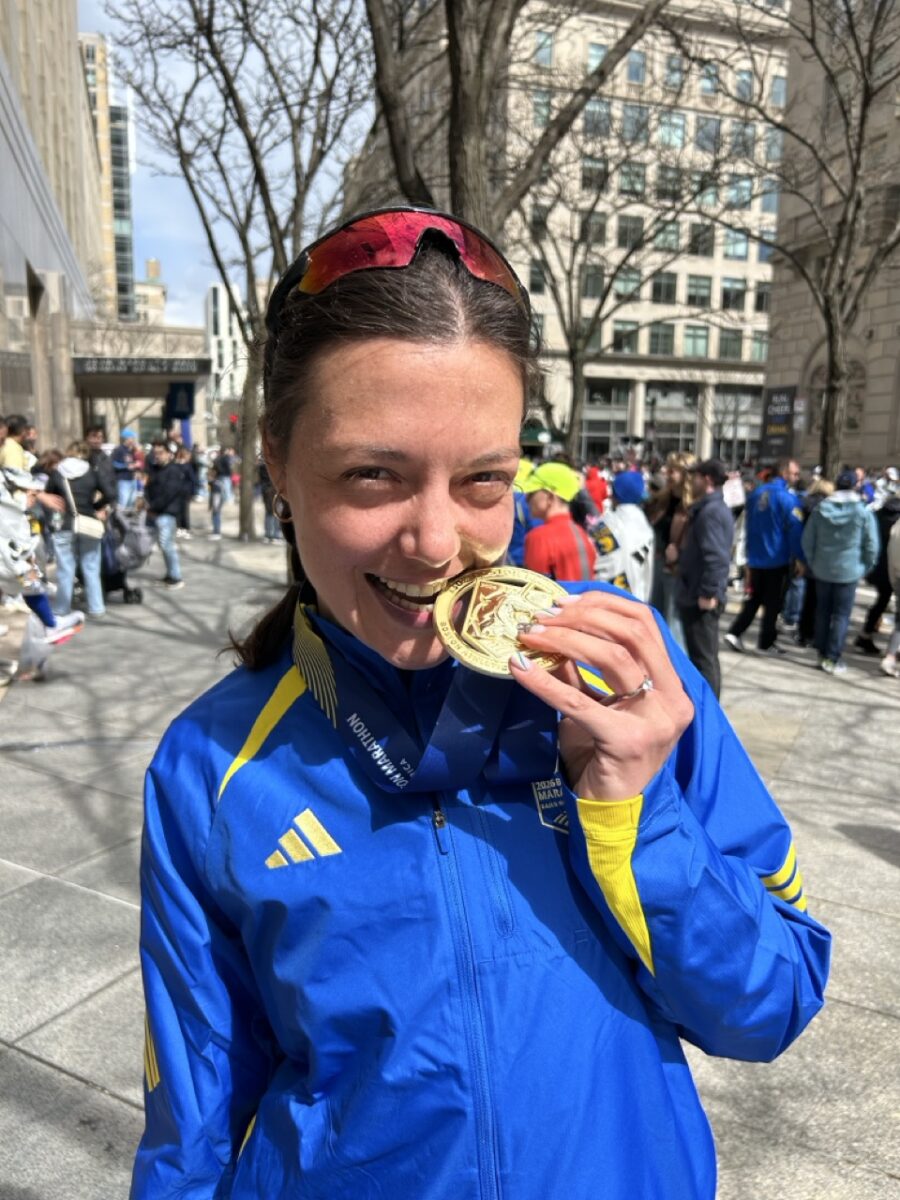
Suddenly, I was experiencing the image that kept playing in my mind in the years and weeks leading up to this moment: right on Hereford, left on Boylston, that finish line coming into view, crossing it with strength and my arms up in the air, a medal around my neck, and hugs after the finish line.
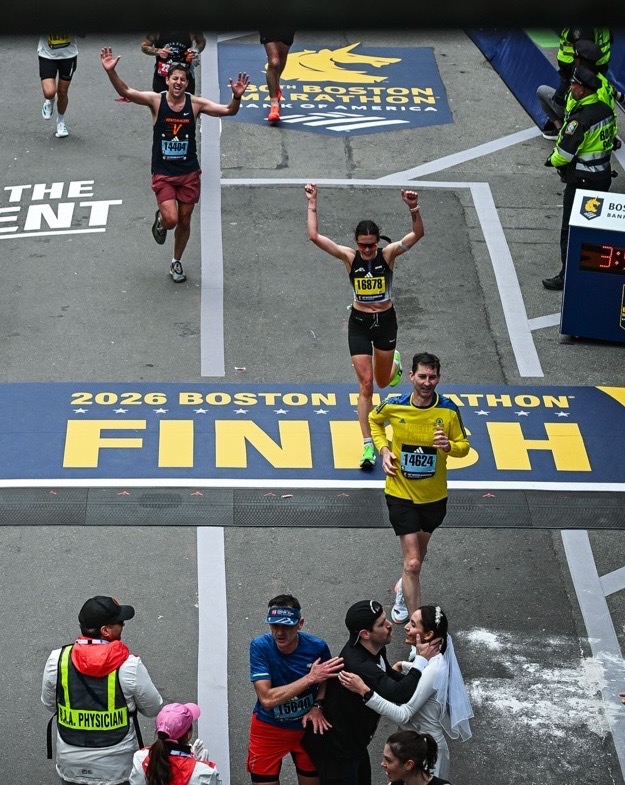
3:15:39 — twenty seconds faster than the A goal. I DID THAT. A dream turned into reality.
There was an incredible mix of emotions that surrounded all of these running experiences: determination, relief, pride, but also disbelief, disappointment, and acceptance. But in all of them, I’ve always felt a grounding sense of gratitude.
I’m grateful for a healthy body, such a loving and encouraging support system around me, and the big dose of luck I’ve been blessed with too.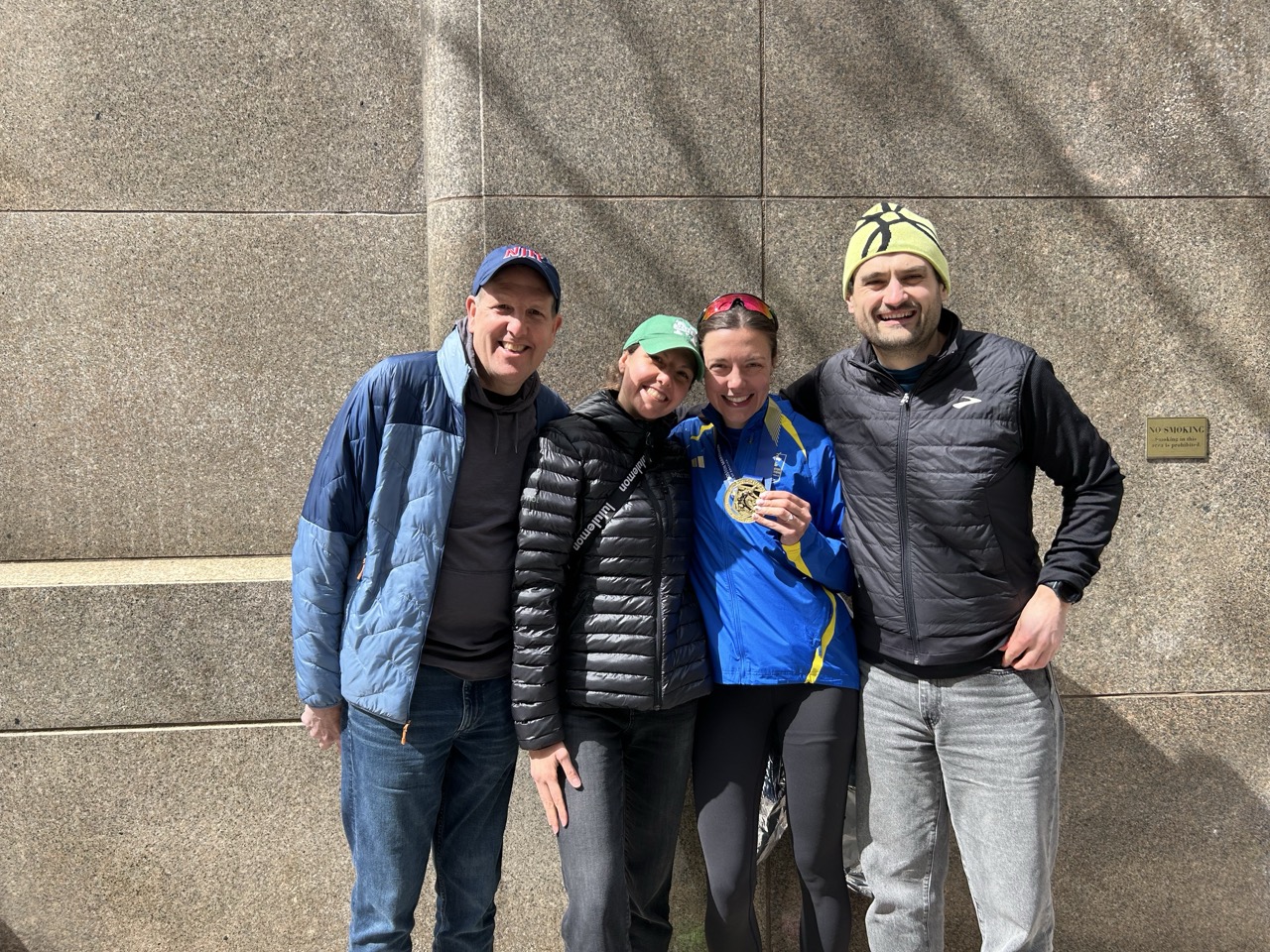
A tip I once heard for considering the impact of certain decisions involves asking “would this make 80-year-old-me proud?” but I also like to think about 8-year old me, 15-year-old me, 27-year-old-me – all those versions of me that lived through the highs and lows of both running and life – would she be proud?
Written on the bottom of my race shoes were reminders: go do the thing you dreamed about and make little you proud. THIS IS THE GOOD STUFF. HOW LUCKY AM I?
I’m so grateful that “younger me” stuck with it. She didn’t throw in the towel. She put in the work even when a lot of those runs felt pretty awful and the progress was anything but linear. Her phone in an armband, MapMyRun in the background, and all sorts of aches and pains popping up and requiring attention. She figured out a fueling strategy, she found supershoes that didn’t cause pain, and she kept going. That girl went on to complete 10 half marathons and 5 marathons.
I’m so grateful to her for that discipline and believing that one day, her dreams really would be within reach.
It feels surreal to even type this, but as of April 20, 2026, I’m a Boston Marathoner. That feels pretty special.